This week, You! spotlights some of Pakistan’s most celebrated contemporary calligraphy artists…
art
Pakistani calligraphy is undergoing an exciting renaissance. Younger artists are taking centuries-old scripts like Thuluth, Naskh, Kufic, and Diwani, and blending them with bold, modern colour palettes, cross-disciplinary styles, and even social commentary. Many are self-taught or using digital platforms to share and market their work globally, bringing fresh energy into what is often viewed as a traditional and formal art form. And with Calligraphy Day celebrated on August 13, there’s no better time to appreciate how today’s artists are keeping the spirit of this heritage alive, while making it their own…
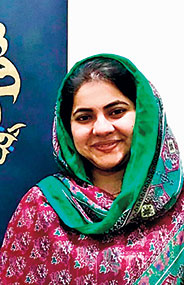
Originally from Bannu and now based in Peshawar, Kiran Shah Bukhari, also known as Kiran Shah Bee, is one of the most recognisable young faces in Pakistan’s modern calligraphy space. Her journey began not in a fine arts studio, but through self-guided practice and YouTube tutorials. It was during her first year of university that she discovered the power and peace of Arabic script, and what started as a personal hobby soon became a full-fledged passion.
Kiran’s work showcases a wide mastery of classical forms including Thuluth, Kufic, Naskh, and Diwani, but what makes her pieces stand out is the contemporary flair she brings to traditional scripts. Her compositions often feature Quranic verses delicately woven into modern brush techniques, with soft colour gradients and expressive textures that are instantly recognisable. She’s also exploring Iranian Wassay scripts and Sufi-inspired motifs, adding layers of meaning and mysticism to her work.
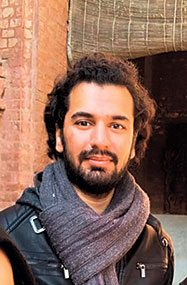
Ali Asad Naqvi, based in Lahore, is a calligrapher who refuses to play it safe. His canvases are marked by a fearless interplay of colour, form, and script.
Trained in the traditional forms but unafraid of rebellion, Ali’s work often features bold geometric patterns, stylised Arabic letters, and the occasional appearance of birds or abstract symbols, giving the impression of calligraphy in motion.
Inspired by Ottoman-era calligraphers, Rumi’s poetry, and the philosophical divide between East and West, his compositions straddle both worlds. He frequently mixes media, photography, acrylic, wood, gold leaf, and even textiles, to tell stories that are both culturally rooted and visually universal.
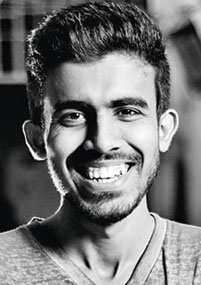
Abdullah Ahmed Khan, better known as Sanki King, is anything but conventional. Born in Jeddah and raised between Saudi Arabia and Pakistan, he grew up at the intersection of cultures. Today, he’s widely regarded as Pakistan’s first major street and graffiti artist, blending elements of calligraphy with urban expression, creating what he calls ‘calligraffiti’.
His work is wild, colourful, and deeply rooted in hip-hop, skateboard, and street art culture. Abdullah paints murals, sneaker art, canvases, walls, even cars, often working live at public events or cultural festivals. His scripts are mostly freestyle, influenced by both Arabic and Urdu letterforms, but warped into modern, almost abstract configurations. Abdullah’s pieces are often more than just visual, they’re performative, designed to disrupt the monotony of urban life and bring script into public consciousness. He has painted in cities across Pakistan, collaborated with international brands, and even taken part in global urban art exhibitions.
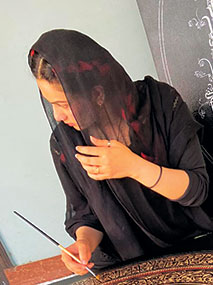
Lahore-based calligrapher Ayesha Kamal grew up in awe of the works of Sadequain, especially the pieces housed in the Lahore Museum. Her early exposure to his dramatic lines and spiritual intensity left a lasting impression, prompting her to explore calligraphy as not just an art form, but a devotional and philosophical practice.
Under the mentorship of Amir Kamal, she began her formal training in calligraphy and steadily grew into one of the most refined talents of her generation. Ayesha has spent years mastering traditional scripts like Thuluth, Moalla, Shikasta, and most distinctively, Kufic, a script known for its angularity and minimalist elegance. She has a particular reverence for ‘Surah Ar-Rahman’, which features heavily in her work. Her canvases are often large, carefully composed, and created using acrylics, oils, silver leaf, and other layered materials that give her work a luminous, almost meditative quality.
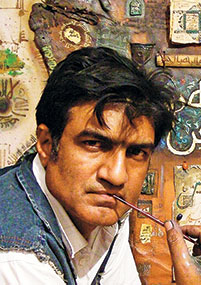
Hailing from Mian Channu, a small city in Punjab, Azeem Iqbal’s relationship with calligraphy began in childhood, a passion that would go on to define his life and artistic contribution to Pakistan’s visual culture. Though entirely self-taught, Azeem’s mastery over classical scripts such as Kufi, Sulus (Thuluth), and Naskh has been honed over decades of rigorous practice and public engagement. What sets him apart is not just technical excellence, but his commitment to making calligraphy visible in everyday life. He has created monumental signage and large-scale installations for some of the country’s most significant institutions, including the ‘National Monument Museum’, the ‘National Book Foundation’, and the iconic ‘Azadi Train’, a moving gallery that celebrated Pakistan’s independence.
Azeem also taught calligraphy at the Rawalpindi Arts Council for many years, where he not only instructed students but championed the cultural preservation of calligraphic traditions that were at risk of fading into obscurity. His workshops, held in schools, cultural centres, and even roadside spaces, are less about performance and more about people, bringing the art form to those who may never have entered a gallery.
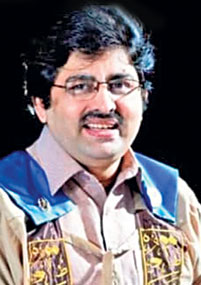
Muhammad Ali Zahid isn’t just a calligrapher, he’s a national pride story. He is based in Lahore, Pakistan, and in 2021 became the first Pakistani calligrapher to win the ‘Albaraka Türk International Calligraphy Competition’, standing out for his classical precision and technical mastery, an event long dominated by Middle Eastern and Turkish masters.
His win marked a major milestone, not just for his own career, but for Pakistan’s representation on the international calligraphy map. What defines his work is an uncompromising commitment to precision. Trained in classical Arabic scripts, he brings technical mastery to the fore, his compositions are crisp, balanced, and steeped in tradition. He does not chase trends or gimmicks; instead, his strength lies in command over the script and the discipline required to produce truly timeless pieces.