
Russia opens door to diplomacy in Ukraine standoff
Pentagon spokesman John Kirby says Washington still does not believe Moscow has made a final decision on whether to invade Ukraine
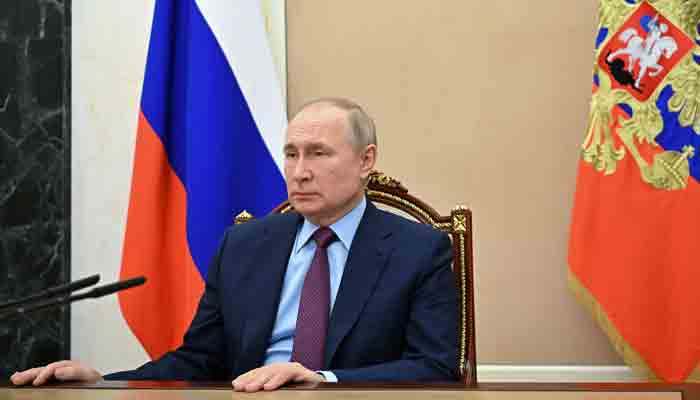
MOSCOW: Russia appeared to open the door Monday to a diplomatic resolution of the deepening Ukraine standoff, as the United States said it believed Vladimir Putin had yet to make a final decision on invading the ex-Soviet state.
While Russia said it was ending some military drills, signalling a possible easing of the crisis, in Washington the alert level remained high -- with a top official calling the threat of invasion "more real than ever before."
As speculation mounted that Russian troops massed on the Ukraine border could launch an attack this week, German Chancellor Olaf Scholz was due in Moscow on Tuesday for talks with the Russian president -- the latest in a series of visits by European leaders aimed at avoiding a full-blown conflict.
Previous visitors have been given short shrift by the Russian leader and his top aides, who have consistently argued that the current crisis is the result of the United States and western Europe ignoring Moscow’s legitimate security concerns.
But a carefully choreographed meeting Monday between Putin and his foreign minister, Sergei Lavrov, seemed to signal a change in tone, with the latter stressing there was "always a chance" for agreement with the West over Ukraine.
Exchanges with leaders in European capitals and Washington showed enough of an opening for progress on Russia’s goals to be worth pursuing, he told Putin.
"I would suggest continuing," Lavrov said in televised remarks. "Fine," Putin replied.
At the United Nations, Secretary-General Antonio Guterres insisted "there is no alternative to diplomacy," and warned that abandoning such an approach in favour of confrontation would equate to "a dive over a cliff."
As the Russian remarks were seized on by some as offering hope of a de-escalation, the Pentagon said Moscow’s forces on the border with Ukraine were still growing, "to well north of 100,000."
Pentagon spokesman John Kirby said Washington still did not believe Moscow had made a final decision on whether to invade.
But the United States said it was joining other nations in relocating its Kyiv embassy to the western city of Lviv, in light of the "dramatic acceleration" of the buildup.
"It is a distinct possibility, perhaps more real than ever before, that Russia may decide to proceed with military action, with new Russian forces continuing to arrive at the Ukrainian border," State Department spokesman Ned Price told reporters.
Scholz to Moscow
As Western intelligence officials warned that Wednesday could mark the start of an invasion, Ukrainian President Volodymyr Zelensky appeared to dismiss the suggestion in a video address to the nation announcing the day would be marked as "Unity Day."
"They tell us that February 16 will be the day of the invasion. We will make this into Unity Day," Zelensky said -- urging his fellow countrymen to fly the national flag in defiance.
Western leaders consider the Russian troop build-up to be the worst threat to the continent’s security since the Cold War, and have prepared a crippling package of economic sanctions in response to any attack on Ukraine -- although Moscow has repeatedly said it has no such plans.
Recent Russian military exercises, including with Belarus, where the US said Moscow had dispatched 30,000 troops for more than a week of drills, further raised concerns -- although Russian Defence Minister Sergei Shoigu told Putin Monday that some of the drills were "ending."
During a news conference in Kyiv with Zelensky, Scholz said there was "no reasonable justification" for the build-up of troops, vowing Berlin and its allies would maintain support for Ukraine’s security and independence.
Speaking alongside Scholz, Zelensky meanwhile repeated that joining the NATO alliance would guarantee Ukraine’s survival -- a key sticking point in negotiations between Russia and the West.
But as he prepared to head to Moscow, Scholz appealed to Russia to take up "offers of dialogue."
Germany already plays a central role in efforts to mediate in eastern Ukraine, where a gruelling conflict with Russian-backed separatists has claimed more than 14,000 lives.
Germany’s close business relations with Moscow and heavy reliance on Russian natural gas imports have however been a source of lingering concern for Kyiv’s pro-Western leaders and US President Joe Biden’s administration.
‘Digging trenches’
While waiting for diplomacy to bear fruit, on the front line separating Kyiv-held territory from areas controlled by Moscow-backed insurgents in the east, underprivileged children in the care of church groups were helping with war preparations.
"We are digging trenches that Ukrainian soldiers could quickly jump into and defend in case the Russians attack," 15-year-old Mykhailo Anopa told AFP.
In Moscow, Russians showed no appetite for war.
"People in the West do not understand that we are one people," Pavel Kuleshov, a 65-year-old pensioner, told AFP, referring to Russians and Ukrainians. "Nobody wants a civil war."


-
 Rosie O’Donnell secretly returned to US to test safety
 -
 'Harry Potter' star Rupert Grint shares where he stands politically
 -
 Drama outside Nancy Guthrie's home unfolds described as 'circus'
 -
 Marco Rubio sends message of unity to Europe
 -
 Hilarie Burton reveals Valentine's Day plans with Jeffrey Dean Morgan
 -
 Jacob Elordi, Margot Robbie on 'devastating' scene in 'Wuthering Heights'
 -
 China to implement zero tariffs on African imports in major trade shift
 -
 Jack Thorne explains hidden similarities between 'Lord of the Flies' and 'Adolescence'