
Chinese court holds off ruling on Canadian´s death penalty appeal
Robert Lloyd Schellenberg, 36, was sentenced to death in January after a court deemed his previous 15-year prison sentence too lenient.
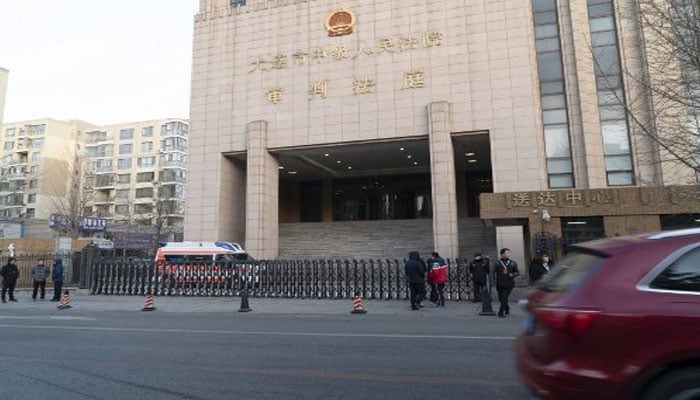
BEIJING: A Chinese court adjourned a hearing on a Canadian man´s appeal against his death sentence for drug smuggling without a decision Thursday in a case that has deepened a diplomatic spat between Beijing and Ottawa.
Robert Lloyd Schellenberg, 36, was sentenced to death in January after a court deemed his previous 15-year prison sentence too lenient.
His appeal hearing came a day after a top executive of Chinese telecom giant Huawei, Meng Wanzhou, appeared in court in Canada to fight a US extradition bid that triggered the diplomatic storm.
The Liaoning High People´s Court in northeast China said in a statement that "all procedural rights of appellant Schellenberg were guaranteed in accordance with the law".
The trial has adjourned and the court will "select a day or time to pronounce the sentence," it said without specifying.
Schellenberg´s case is seen as potential leverage for Meng, who was arrested on a US extradition request related to Iran sanctions violations -- a link that Beijing has repeatedly denied.
Following the Huawei executive´s arrest in December, China detained former Canadian diplomat Michael Kovrig and businessman Michael Spavor, in what observers saw as retaliation.
Canadian Prime Minister Justin Trudeau has said that China had "chosen to arbitrarily" sentence Schellenberg to death. His government has pleaded for clemency.
Ottawa said Wednesday it was "extremely concerned that China has chosen to apply the death penalty, a cruel and inhumane punishment".
Canadian officials were expected to attend Thursday´s hearing.
- Canadians detained -
Schellenberg was originally sentenced to 15 years in prison and a 150,000 yuan ($22,000) forfeiture in November.
But following an appeal, the high court in Liaoning ruled in December that the sentence was too lenient given the severity of his crimes.
About a month later, his sentence was changed to capital punishment.
China has executed foreigners for drug-related crimes in the past, including a Japanese national in 2014, a Filipina in 2013, and a Briton in 2009.
Last week another Canadian, Fan Wei, was sentenced to death for drug trafficking in a separate case in southern China.
Kovrig and Spavor, meanwhile, have been denied access to lawyers and are allowed only monthly consular visits.
Days after Canada launched the extradition process against Meng in March, China announced it suspected Kovrig of spying and stealing state secrets. It alleged fellow Canadian Spavor had provided him with intelligence.
Meanwhile, Huawei´s Meng was back in court in Vancouver on Wednesday, with her lawyers arguing that the US case was politically motivated.
Her firm says she is innocent.
Huawei is also in the US crosshairs as Washington seeks to convince Western nations to shun the telecom firm over security concerns.
The diplomatic row appears to have has spilled over into the economic arena: China has banned Canadian canola and pork shipments worth billions of dollars.
Ottawa has pressed Washington -- which is locked in a trade dispute with China -- to step up its pressure on behalf of the detained Canadians.




-
 Daniel Radcliffe reveals surprising way fatherhood changed him
 -
 Alan Cumming shares plans with 2026 Bafta Film Awards
 -
 OpenClaw founder Peter Steinberger hired by OpenAI as AI agent race heats up
 -
 Chinese New Year explained: All you need to know about the Year of the Horse
 -
 Canadian passport holders can now travel to China visa-free: Here's how
 -
 Edmonton weather warning: Up to 30 cm of snow possible in parts of Alberta
 -
 ICE agents 'fake car trouble' to arrest Minnesota man, family says
 -
 China confirms visa-free travel for UK, Canada nationals