‘Immortal’ jellyfish could hold clues to slowing human ageing
Scientists hope to identify the molecular "switch" controlling this process to apply similar mechanisms to human cells
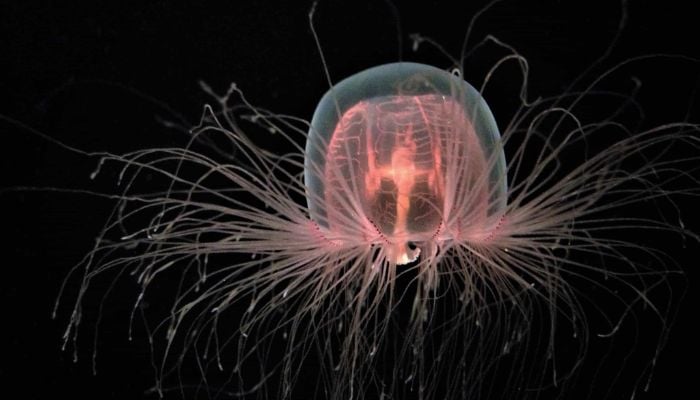
The immortal jellyfish could hold the secret to fight ageing due to its ability of reversing its lifecycle to become young again. Scientists are finding this helpful in unlocking potential anti-ageing treatments for humans.
The translucent jellyfish Turritopsis dohrnii can revert from its adult form (medusa) back into a ball of cells (cyst), which then grows into a polyp colony capable of producing hundreds of new jellyfish when it feels stressed, injured, or starved.
Scientifically speaking its adult cells undergo "transdifferentiation" in which the cells revert into an undifferentiated stem-cell-like state before specializing into new cell types needed for the polyp stage.
So each new jellyfish developed through this process can potentially repeat the cycle, making the species "uniquely capable of biological time-reversal in the animal kingdom.”
Michael Koldobskiy, a pediatric oncologist and physician-scientist at Johns Hopkins, said "The holy grail of this kind of thing, I think, would be regenerative biology: trying to reverse ageing-related degeneration or degradation.”
The marine biologist Maria Miglietta of Texas A&M University at Galveston and other researchers are now delving deep into molecular genetics to understand the whole process of regeneration.
The jellyfish possesses extra copies of genes for repairing mutations and DNA damage that accumulate with age.
Moreover, T. dohrnii has additional genes responsible for maintaining telomeres. Research shows specific gene activity peaks during the ball-like cyst stage, with overlaps found between T. dohrnii genes and genes linked to longevity in humans.
Potential human applications
Scientists hope to identify the molecular "switch" controlling this process to apply similar mechanisms to human cells.
Rather than turning humans into babies, the realistic goal is tissue and organ-level rejuvenation, accelerating wound healing, restoring damaged tissue after heart attacks or strokes, and treating conditions like Alzheimer's or vision loss.
Koldobskiy said, "We're a long way away from harnessing that for human benefit, but I think understanding these organisms that evolved these processes millions of years ago could potentially really pay off."
But there are some limitations too as the jellyfish can still die in the wild due to various factors including starvation, predators and changing ocean conditions.


-
 Ebola crisis worsens in DR Congo as virus reaches eighth province with over 4,500 dead
-
 Study finds eating blueberries every day can surprisingly boost your mood
-
 Eli Lilly’s Foundayo weight-loss pill gets European approval recommendation
-
 What is BPC-157? Trump administration considers easing rules on popular peptide injections
-
 West Nile virus: Europe reports 141 deaths as human cases rise in 2026
-
 Health Canada reviewing new mRNA flu vaccine that could prevent more hospitalisations
-
 Scientists discover hidden drainage route at the back of the eye
-
 WHO confirms death at Russian research lab, says no plague case registered