Mount Etna may have different origin as study reveal new facts about its formation
Researchers say fresh geological evidence points to a different origin for Europe's most active volcano, Mount Etna
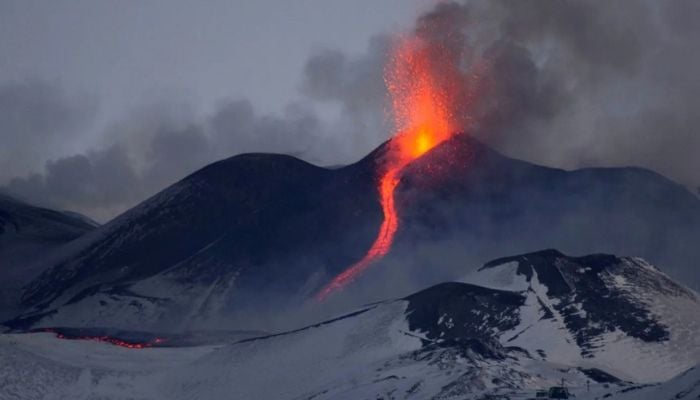
In a major discovery scientists has revealed new secrets about Europe's most active volcano "Mount Etna".
Mount Etna has long puzzled geologists because it doesn't fit any of the ways volcanoes are thought to form.
A new study suggests it may instead be fueled by ancient pockets of magma that are pushed upward through cracks created by shifting tectonic plates.
For decades, Etna Europe’s tallest and most volatile active volcano has been a complete geological anomaly.
It erupts frequently on the Italian island of Sicily.
yet it has stubbornly refused to fit into any of the three traditional categories that scientists use to explain how volcanoes form.
Volcanoes form when molten rock from Earth's mantle rises to the surface and hardens. Traditionally, geologists have grouped volcanoes into three main types based on how that magma is generated.
At the boundary between two tectonic plates, where the plates move apart and allow mantle material to rise and melt, creating new ocean floor.
At subduction zones, where one tectonic plate sinks beneath another and water carried into the mantle lowers the melting point of surrounding rock, producing magma and often explosive volcanoes such as Mount Fuji in Japan.
Or thirdly in the hotspot, where unusually hot mantle material rises, forming volcanic island chains such as Hawaii or La Réunion.
More than 500,000 years old and rising more than 3,000 meters or 9,800 feet above sea level, Mount Etna has long resisted attempts to fit it into existing models of volcano formation.
Although it sits near a subduction zone, the chemical makeup of its lava more closely resembles volcanoes formed above hotspots, even though no hotspot exists beneath the region.
New study suggests Mount Etna may have formed through a rare volcanic process unlike the one behind any other large volcano on Earth, making it potentially different rest.
The researchers propose that Etna is supplied by small pockets of magma that already exist in the upper mantle about 80 kilometers (50 miles) below the surface.
The mechanism explain both Mount Etna's unusual chemistry and its long history of frequent eruptions.
Instead of forming shortly before eruptions, as is typical for many volcanoes, this magma may have remained in place for long periods before being pushed upward.
If confirmed, Etna could belong to a rare fourth category of volcano, revealing that much larger volcanoes can form through processes previously associated only with small submarine eruptions.
Notably, the new findings, published in the Journal of Geophysical Research "Solid Earth," were developed in collaboration with Anna Rosa Corsaro of the Istituto Nazionale di Geofisica e Vulcanologia in Catania.





-
 What did NASA capture? Chief says mysterious UFO images remain unexplained
 -
 Are Milky Way’s coldest stars actually alien megastructures? New study explores
 -
 China takes major step toward reusable rockets with sea-based booster recovery test
 -
 Species under threat: Viral 'squeaky frog' faces extinction risk
 -
 China reveals plans for an asteroid early-warning network
 -
 How an exoplanet survived its star’s death is baffling astronomers
 -
 Scientists unveil method to detect nuclear weapons hidden in satellites
 -
 Japan’s ispace partners with SpaceX Starship for moon ride-share missions
-
 Astronomers find oldest known quasars that defy current theories
 -
7.6 billion people could see asteroid Apophis in 2029: Here’s the map
-
NASA’s Hubble at US 250th Anniversary: Blue and white dazzling stars spotted in crimson stellar nursery
-
Mysterious debris found on Australian beaches could be ‘space balls'