New study investigates phenomenon surpassing the speed of light
A unique microscopy system was designed to prove that darkness can travel faster than light
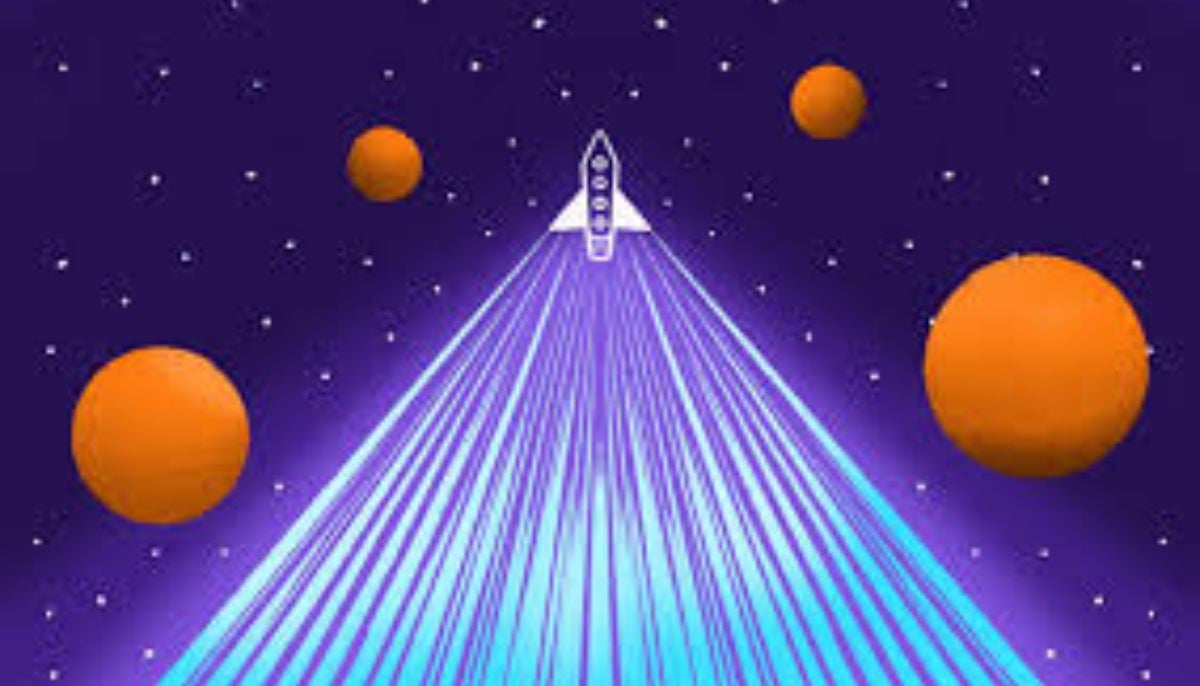
A surprising result has been uncovered: darkness can technically outpace light under specific conditions. While Einstein’s theory states that information cannot travel faster than light, massless phenomena that carry no information, such as darkness, can technically exceed this cosmic speed limit. In this regard, scientists focused on optical phase singularities, which are also called zero points or null points.
These are tiny holes or voids in light waves where the light’s amplitude drops to zero, creating points of complete darkness. However, recent theory has outlined that these singularities can move at superluminal speeds, especially during their annihilation. The research team used a specialized laser and microscopy system to track these dark points. They used a material called hexagonal boron nitride (hBN) to turn light into polaritons. In this polariton state, light is slowed down to roughly 1% of its speed in a vacuum. This reduction made it possible to observe and measure the dark point vortices surpassing the local speed of light.
In this connection, Ido Kaminer, senior author of the study from Technion said in a press statement: “Our discovery reveals universal laws of nature shared by all types of waves, from sound waves and fluid flows to complex systems such as superconductors.”
The researchers are committed to these innovative microscopy techniques which have enabled the study of hidden processes in physics, chemistry, and biology. For the first time, they reveal how nature behaves in its fastest states. Furthermore, this discovery outlines laws of nature that apply to all wave types, including sound and fluid flows. These techniques may eventually help scientists uncover elusive processes across multiple scientific disciplines.


-
 Biden calls out Trump’s ‘vanity projects’ at Maryland Democratic Gala—Here’s why
 -
 Pima County Sheriff responds to new claims in Nancy Guthrie case
 -
 Mayor Mamdani jumps into NYC pool to revive old tradition
 -
 Trump’s Gaza Board of Peace seeks to grant itself total immunity and free use of property: Here’s why
-
 Scientists found 'super-puff' planets 1,110 light-years away
 -
 Scientists find ancient microbial life in places it shouldn't exist
 -
 Why Marijuana is suddenly sending thousands of dogs to hospitals in US?
 -
 36 years on, Hubble shows how stars actually change over time
 -
 Hidden magma beneath Mars? Scientists' 'unexpected' discovery raises new questions about alien life
 -
 Rare 3,200-year-old coral blue hole discovered in South China Sea
 -
 What happens at black hole’s event horizon? Scientists find the first-ever clue
 -
 Scientists discover evidence of fires used by humans 1.8 million years ago
-
 Did NASA just uncover evidence of ancient life on Mars? Key discoveries explained
 -
Four powerful earthquakes strike three continents within hours: Scientific link or coincidence?
-
Mysterious interstellar comet passing our solar system may be 12 billion years old, scientists say
-
When do we really become adults? Science has an answer