Why NASA Artemis II won’t take straight path to Moon: ‘Figure-8’ route explained
Orion is heading towards the lunar orbit after staying in Earth orbit
In a recent development, NASA Artemis II astronauts are heading towards the far side of the moon after freeing themselves from High Earth Orbit.
According to a statement issued by NASA on X, “The Orion spacecraft recently ignited its main engine on the service module for about six minutes to provide about 6,000 pounds of thrust. This maneuver not only sets the Artemis II astronauts on the path to the Moon.”
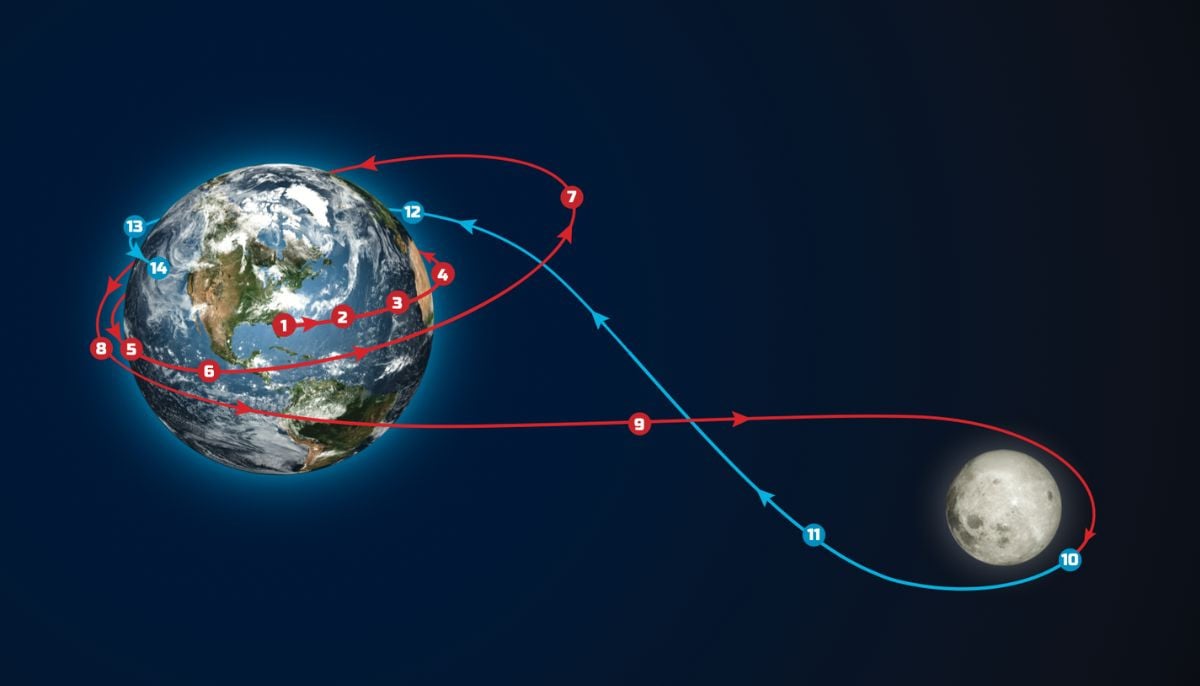
The interesting thing is that the journey of Artemis II is not a simple “point and shoot” mission to the moon. Unlike the Apollo mission which aimed for the fastest direct route to lunar orbit, Artemis II is intentionally taking a more winding, 10 day path, based on “free-return trajectory.”
Safety First approach
Unlike Apollo, which performed a translunar injection shortly after reaching Earth orbit, Artemis II spent its first 24 hours in a highly elliptical Earth orbit to conduct necessary safety checks, ensuring smooth functionality of Orion spacecraft.
The crew also used this time to practice “proximity operations” manually manoeuvring Orion near the spent ICPS rocket stage to test handling qualities.
By simulating the docking manoeuvres, the crew will collect essential data needed for future moon landings.
Gaol is orbit, not just altitude
Traveling in space is not just about going up straight as this straight path would waste huge amounts of fuel. Eventually a fuel-less spacecraft would be pulled back to Earth by gravity.
Hence, to stay longer in space, the spacecraft must travel sideways fast enough that it falls around the curve of the Earth. That’s why Artemis II loops around Earth first before heading out.
Figure-8 path: Free-return trajectory
Artemis II is not entering lunar orbit. Instead, it will follow a “figure-eight trajectory”, swinging the spacecraft around the far side of the Moon. This path is known for using the moon’s gravity as a “slingshot” .
For instance, if Orion’s engine would not work after the “translunar injection” burn, the spacecraft would naturally be pulled back towards Earth by gravity without needing further propulsion or extra burn.
What makes the Artemis II lunar mission distinct is its plan to reach a record-breaking distance from Earth, a distance of over 248,000 miles from Earth, the ever greatest distance from Earth during this stage.
While Apollo missions flew as low as 60–70 miles from the surface, Artemis II will pass between 4,000 and 6,000 miles above the Moon.
This "high-altitude" lunar flyby provides a wider field of view of the lunar far side and keeps the spacecraft in a safer gravitational corridor for the return trip to Earth.
The figure-8 pathway will also give the astronauts an opportunity to conduct deep space tests, helping the agency in future Artemis III and IV missions.


-
 A ‘neglected’ neutrino may hold the key to why the Universe exists
 -
 Can cancer drugs be made in space? Here’s what the new mission aims to find out
 -
 SpaceX Falcon 9 successfully launches Bandwagon-5 mission with 32 payloads
 -
 Europe launched 8 orbital rockets last year, can it rival Starlink?
 -
 Japan launches world’s first mission to bring sample back from phobos
 -
 Orionid meteor shower 2026: Peak date, viewing tips and what to expect
 -
 Why Mars looks blue in NASA’s unedited curiosity panorama?
 -
 Blue Origin upgrades new Glenn rocket launch infrastructure to take on SpaceX