Arizona’s Meteor Crater continues to reveal new discoveries 50,000 years later: Here’s why
New insights continue to be observed from this crater; therefore additional studies are underway for further exploration
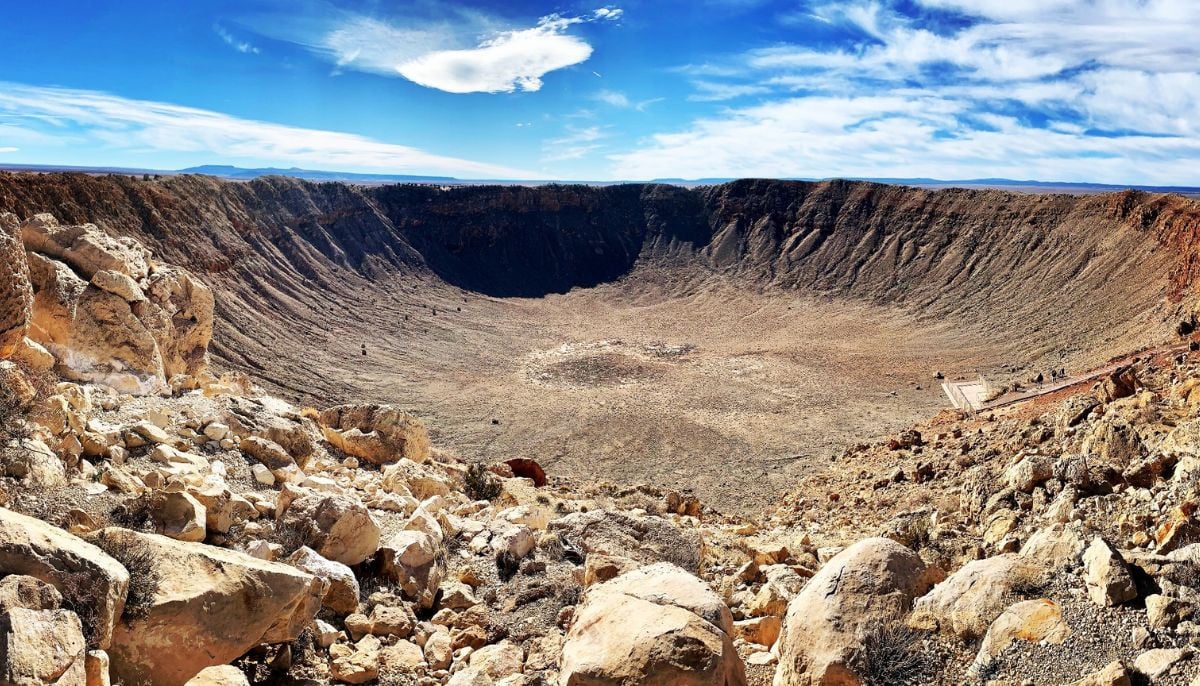
Arizona’s Meteor Crater remains the best-preserved meteorite impact site on Earth. Despite being studied for over a century, recent scientific research in 2025 and 2026 has uncovered surprising new secrets regarding the sheer scale of its impact and its role in future space exploration. It represents the best-preserved meteor impact site in the world, measuring some 700 feet deep, more than 4,000 feet across, and 2.4 miles in circumference.
Features like Meteor Crater continue to be ongoing research sites, generating new data on what happens when objects from the cosmos strike our planet. At present, a number of competitive grants are being offered to support field research at known impact sites globally. According to the scientist Dan Durda, the site is described as a perfect natural laboratory because it is a well-preserved and exposed impact crater on Earth.
The Barringer Crater Company has established grants specifically for students and early researchers to study terrestrial craters. These grants aim to deepen our understanding of crater formation and encourage the next generation of scientists to pursue this specific branch of research.
Meteor Crater: A high-energy geological event still yielding secrets
Impact cratering is described as a high-energy geological event occurring in a very short timeframe, creating conditions that exceed the intensity of nuclear explosions. Scientists use morphological and geophysical surveys to find anomalous structures hidden underground. The prime motive of recognition of an impact site requires proof of shock metamorphic efforts or the presence of meteoritic components that only occur during hypervelocity impacts.
There are currently about 200 confirmed impact craters on Earth. The study of these sites has become a major interdisciplinary effect that bridges distinct scientific fields. The Barringer family fund offers grants to young researchers globally to encourage new studies with an annual deadline of April 1.






-
 Is this Earth 2.0? NASA’s James Webb telescope spots ‘rare’ giant exoplanet
 -
 SpaceX Starship launch delayed again: Here’s what went wrong
 -
 Why do scientists think Neptune’s moon Nereid survived violent cosmic collision?
 -
 NASA set to unveil major Moon Base strategy and mission update
 -
 SpaceX’s upgraded Starship V3 ready for high-stakes test flight: Where to watch live
 -
 Scientists hatch live chickens from 3D-printed eggshells: Could artificial wombs be next?
 -
 SpaceX: Starship V3 all set for debut launch ahead of IPO
 -
 Four alien species recovered from crashed UFOs, Ex-CIA researcher claims