Nvidia’s AI chip dominance faces its biggest test yet: Here’s why
Nvidia is currently the most valuable company in the world, topping $5 trillion valuation
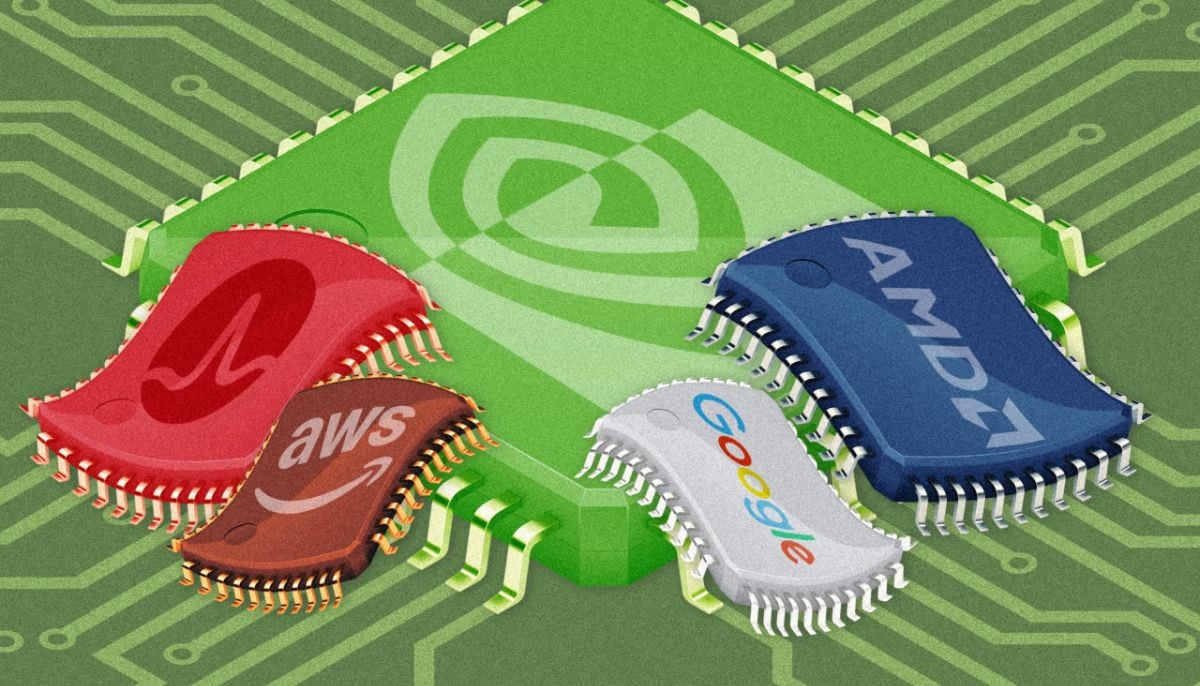
Nvidia, the US-based chipmaker, has maintained its dominance in the chip industry for a decade characterised by selling cutting-edge chips that power AI, cloud computing, and machine learning.
The company’s matchless success is further strengthened by the advanced chip designs and its proprietary software library, CUDA. Nvidia is currently the most valuable company in the world, topping $5 trillion valuation. It sold around $147.8 billion worth of AI-related chips from February to October.
However, Nvidia’s dominance is starting to be challenged by the rival chip designers, tech giants, cloud-computing interlopers, and its own customers, as reported by the Wall Street Journal.
Moreover, Amazon and Google have also entered in the AI chip race with the intention of launching and selling advanced chips, thereby competing with Nvidia’s GPUs.
Chip designer competitors & their advances
Some well-known chip designers are shifting their focus towards AI-powered markets driven by the circular deals and investments.
AMD (Advanced Micro Devices) has recently made an AI-related strategic decision to fulfill the growing demands for computing. The company has also entered major deals to supply chips to Oracle and OpenAI.
Similarly, Broadcom, the $1.8 trillion worth company, is also known for producing custom chips called XPUs for computing and networking hardware. They also struck a multi-billion dollar custom chip deal with OpenAI.
Qualcomm designs chips for cars and mobile devices. Recently, it has announced plans to develop new AI accelerator chips, AI200 and AI250 equipped with energy efficiency and high memory capabilities.
The original Silicon Valley titan, Intel is also making strides in chip design and manufacturing, catering to the needs of advanced data-center processors.
Tech giant interlopers
Tech giants with massive cash reserves are also posing a challenge to Nvidia through hefty investments in AI chips.
Google is known for designing and providing chips called tensor processing units, or TPUs. Now, Alphabet’s parent company is selling TPUs to Nvidia’s customers, including Meta, Anthropic and Apple.
Dylan Patel, founder of influential AI infrastructure consulting firm SemiAnalysis, equated the growing popularity of Google’s chips to “the end of Nvidia’s dominance.”
On the other hand, Amazon Web Services (AWS) has expanded a data-centre cluster for Anthropic which will ultimately house 1 million of Amazon’s Trainium chips.
Nvidia’s own customers
Nvidia’s biggest challenge comes from its own customers who are involved in circular deals with other tech giants and moguls.
Customers like OpenAI and Meta Platforms are beginning to design their own custom chips, posing a fresh challenge to the company’s superiority.
Moreover, these tech companies have also partnered with other tech firms. For instance, OpenAI and Broadcom also struck a partnership to develop custom chips to serve the ChatGPT maker’s computing needs.
Similarly. Meta announced it would acquire chip start-up Rivos to uplift its efforts to develop in-house AI training chips.
Other roadblocks, such as China's ban on Nvidia’s chips have also dampened its dominance in the chip market.


-
 How social media fuels rumors and affects democracy
 -
 ‘AI torture chamber’ experiment sparks backlash: Can AI actually feel pain?
 -
 ChatGPT under attack? OpenAI exposes huge coordinated campaign
 -
 Trump's new name for AI sparks unexpected rush for Slovenia's web domains: Here’s why
 -
 Report reveals fake ChatGPT model hiding malware
 -
 Broadcom’s $42 billion deal with Anthropic: Key details to know
 -
 Is your job next? Ford CEO on AI, spreadsheet work
 -
 X likely to plan new four-tier Grok subscription