AI powers unprecedented Milky Way Model of 100 billion stars to date
The simulation was made successful by integrating advanced Artificial Intelligence algorithms
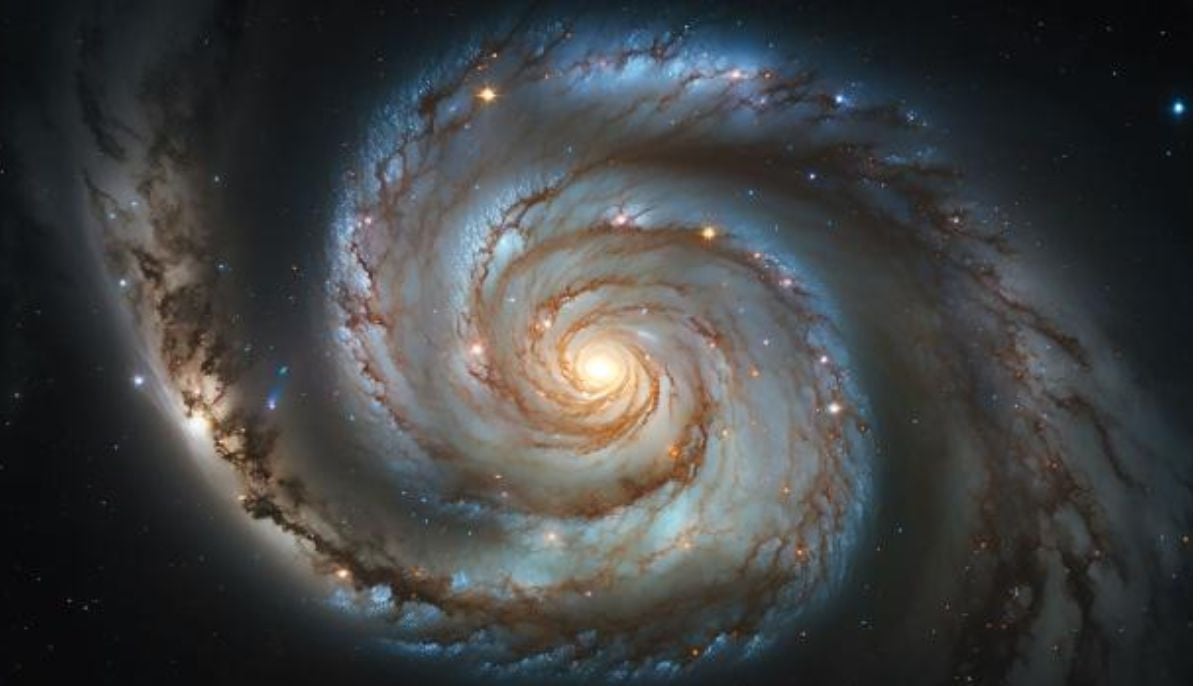
A successful breakthrough has been created by an international research team led by Japan’s Riken, and it is the most detailed model of the Milky Way ever created.
It is primarily achieved by combining machine learning models with numerical models.
The simulation operates 100 times faster than the most elaborate previous models, giving astronomers the chance to map billions of years of our galaxy’s evolution, rather than decades.
The new simulation contains 100 billion particles representing stars, which is approximately the same number of stars that are called the Milky Way.
It has been observed that previous high-fidelity simulations could only manage a billion stars, and their progress was slow.
Using those prior models, simulating one million years of galactic evolution in detail would take 315 hours (or 13 days).
Simulating a billion years using those best-resolution simulations would take 36 years of real computing time.
A new super-computer powered simulation is being developed to study its efficacy
The research team led by Keiya Hirashima of the RIKEN Center for Interdisciplinary Theoretical and Mathematical Sciences in Japan have designed a new supercomputer- powered simulation that is more efficient, and this new methodology works for short and long-term scale events.
The new technology helped to process things more efficiently, with a million years of simulation taking just 2.7 hours.
It will take just 115 days, rather than 36 years, to model a billion years’ worth of galactic evolution.
A giant leap towards the transformative journey
The significant achievement where AI helped build the most detailed Milky Way simulation represents a paradigm shift in scientific modeling.
The new methodology could be transformative for analyzing the context of galactic evolution, and analyzing how our galaxy formed, and its structure developed.
The recent achievement demonstrates how AI-powered simulations can move beyond recognition to become a powerful tool for scientific discovery, aiding our understanding of how life formed within our galaxy.
Nonetheless, the study presents the crucial role of artificial intelligence in surmounting insuperable obstacles.


-
 Iran may have used Chinese-made missile to down US fighter jet, sources say
 -
 US claims $1billion Iranian crypto assets, aims to confiscate properties, says Bessent
 -
 John Travolta introduces daughter Ella in 'Propeller One-Way Night Coach'
 -
 Canada’s economy flatlines amid trade war pressure and weak investment
-
 Koji: World’s first AI tutor that teaches kids how to think, not memorize
 -
 Meta's AI spy tool is capturing EU employee data: Here’s why
 -
 Meta plans AI pendant, ‘wearables for work’ in hardware expansion
 -
 Nvidia wants to turn your backyard into mini AI data center: Here’s how US homeowners could benefit
 -
 US senator probes TikTok, Oracle-linked joint venture over data security concerns
 -
 Meta’s employee tracking tool sparks EU privacy concerns over AI training use
 -
 Qualcomm rolls out AI chip for low-cost Windows PCs
 -
 iPhone 18 Pro dummy units reveal 4 new colour options
-
 AI decoded 400-year-old Vatican cipher in 29 minutes flat
 -
Court ruling on Google advertising tools may transform online ads
-
LinkedIn founder predicts next AI boom after chatbots: Here’s what comes next
-
UN issues landmark global guidelines for child online safety
-
AI can help revive Italy’s sluggish labour productivity, Fabio Panetta says
-
Anthropic overtakes OpenAI with record $900 billion valuation
-
OpenAI gives Japanese banks access to GPT-5.5 to fight cyberattacks
-
Putin says AI replacing human jobs is inevitable: ‘Entire professions may go extinct’
-
Putin says AI job losses are inevitable: Here’s Russia’s strategy
-
Anthropic releases Claude Opus 4.8: Check what’s new