SpaceX answers critics with successful Starship test flight
Starship is key to founder Elon Musk's vision of carrying humanity to Mars
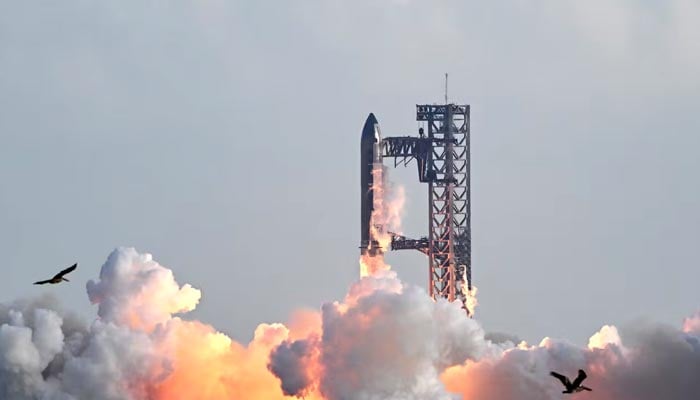
SpaceX's Starship megarocket roared into the skies Tuesday on its tenth test flight, turning in a strong performance after a series of fiery failures had begun to cast doubt on its future.
Towering 403 feet (123 meters), Starship is the most powerful launch vehicle ever built and key to founder Elon Musk's vision of carrying humanity to Mars, as well as NASA's plans to return astronauts to the Moon.
The stainless steel colossus blasted off from the company´s Starbase in southern Texas at 6:30 pm local time (2330 GMT), greeted by loud cheers from engineering teams, as seen in a live webcast.
A few minutes into launch, the first-stage booster known as Super Heavy splashed down into the Gulf of Mexico, triggering a sonic boom on its way. Unlike other recent tests, SpaceX opted not to attempt a catch with the giant "chop stick" arms of the launch tower, instead testing how it would perform if an engine cut out.
Attention then shifted to the upper stage — also known individually as Starship and intended to one day carry crew and cargo — to demonstrate its capabilities as it soared into space.
For the first time, SpaceX was able to successfully deploy eight dummy Starlink internet satellites, with onboard cameras beaming back live views of a robotic mechanism pushing each out one by one.
It was not all smooth sailing. Some heat tiles fell away and a small section of a flap burned off during the vessel´s fiery descent, as it was enveloped in pink and purple plasma.
But SpaceX communications manager Dan Huot said much of this was expected as the vehicle was intentionally flown on a punishing trajectory with some tiles removed.
"We're kind of being mean to this starship a little bit," he said on the webcast. "We're really trying to put it through the paces and kind of poke on what some of its weak points are."
"Great work by the SpaceX team!!" Musk wrote on X.
'Critical mission'
Much had been riding on the mission, after the last three flights ended with the upper stage exploding: twice over the Caribbean and once after reaching space. In June, an upper stage blew up during a ground test.
Despite recent setbacks, Starship was not seen as being at a crisis point. SpaceX´s "fail fast, learn fast" philosophy has already given it a commanding lead in launches with its Falcon rockets, while Dragon capsules ferry astronauts to the ISS and Starlink has become a geopolitical asset.
Still, even with a successful tenth flight, major challenges loom. Musk has identified developing a fully reusable orbital heat shield as the toughest task, noting it took nine months to refurnish the Space Shuttle´s heat shield between flights.
"What we´re trying to achieve here with Starship is to have a heat shield that can be flown immediately," he said on a webcast Monday.
Another hurdle is proving Starship can be refuelled in orbit with super-cooled propellant — an essential but untested step for the vehicle to carry out deep-space missions.
Time is running short to ready a modified version as NASA's lunar lander for 2027, and for Musk to make good on his vow to send an uncrewed Starship to Mars next year.


-
 How dogs became man’s best friend 15,800 years ago: New study reveals
 -
 Real-life ‘Project Hail Mary’ moment: 45 planets that may support alien life discovered
 -
 CERN successfully transports antimatter for first time in historic breakthrough
 -
 Astronomers spot solar system lookalike 87 light-years away
 -
 From Moon base to nuclear spacecraft: Inside NASA’s strategic overhaul to win space race against China
 -
 Northern lights wane, but watch for midnight surprise to dazzle the sky
 -
 NASA, South Korea team up for L4 deep space exploration mission
 -
 Scientists use ‘Space Archaeology’ to rebuild hidden history of giant spiral galaxy