Jupiter used to be twice as big as it is now: study
New research says planet is said to have magnetic field at least 50 times stronger than what it has today
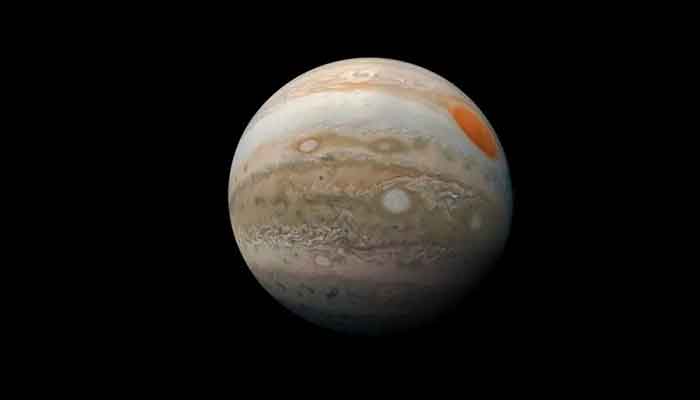
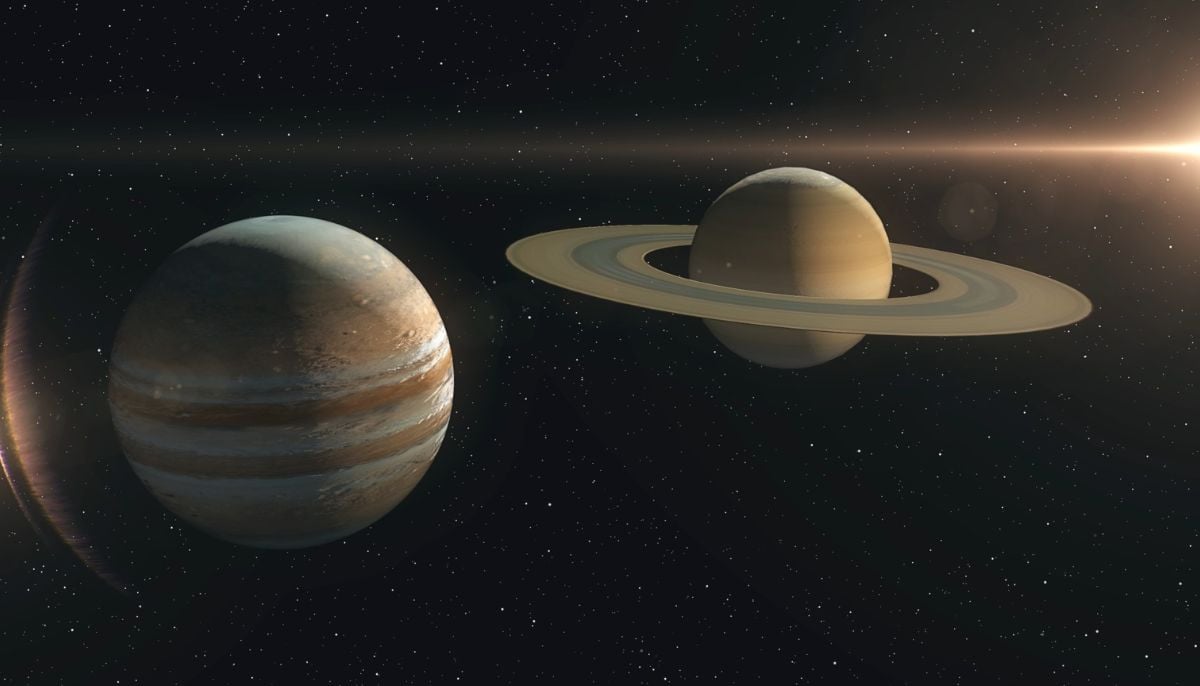
Before Jupiter became the giant planet it is today, it was much larger and had a much stronger magnetic field, according to a recent study that peered back in time to depict what the planet looked like in its early years.
New calculations show that just 3.8 million years after the formation of the first solid objects in the solar system, Jupiter was twice as massive as it is today and had a magnetic field at least 50 times stronger than it has now. A study that was published in the journal Nature Astronomy on Tuesday, May 20, detailed these discoveries, reported Space.com.
"Our ultimate goal is to understand where we come from, and pinning down the early phases of planet formation is essential to solving the puzzle," Konstantin Batygin, a professor of planetary science at the California Institute of Technology, who led the new study, said in a statement. "This brings us closer to understanding how not only Jupiter but the entire solar system took shape."
Batygin and his team mostly avoided the presumptions of current planetary formation models, such as the rate at which young planets gathered primordial gas, in order to expose Jupiter's earliest planetary circumstances. Rather, they concentrated on Amalthea and Thebe, two of Jupiter's lesser-known moons.
Scientists believe that the slightly slanted orbits of these tiny satellites, which circle quite near Jupiter, have not changed since the early days of the solar system. The latest study claims that the researchers were able to reverse-engineer Jupiter's initial size and magnetic strength by examining such minute orbital tilts.
According to the team's estimations, youthful Jupiter had a volume that could have contained more than 2,000 Earths and a radius that was almost twice as large as it is now. The planet's current volume is sufficient to accommodate 1,321 Earths.
The study highlights that Jupiter's birth and early growth played a "pivotal role" in forming the general architecture of the solar system, even though it doesn't specifically examine how such a huge Jupiter would have affected the early solar system.


-
 Real-life ‘Project Hail Mary’ moment: 45 planets that may support alien life discovered
 -
 CERN successfully transports antimatter for first time in historic breakthrough
 -
 Astronomers spot solar system lookalike 87 light-years away
 -
 From Moon base to nuclear spacecraft: Inside NASA’s strategic overhaul to win space race against China
 -
 Northern lights wane, but watch for midnight surprise to dazzle the sky
 -
 NASA, South Korea team up for L4 deep space exploration mission
 -
 Scientists use ‘Space Archaeology’ to rebuild hidden history of giant spiral galaxy
 -
 How to see NASA’s SLS rocket before the Artemis II launch: Here’s everything to know