Moon-mining machine: US startup unveils helium-3 harvestor prototype
"High-rate excavation needed to harvest helium-3 from moon in large quantities has never been attempted before", says official
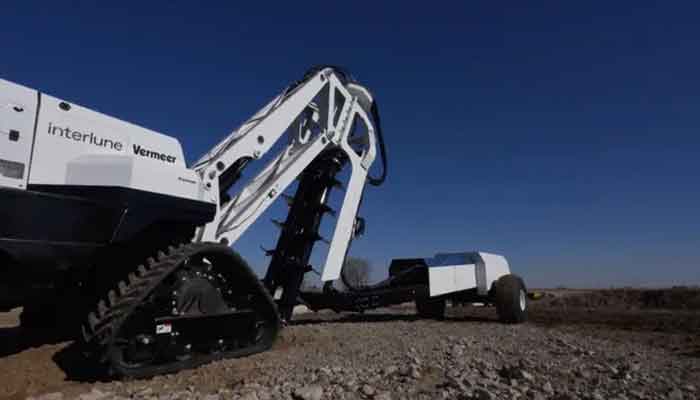
US-based start up Interlune has unveiled helium-3 harvestor prototype for a novel moon-mining machine.
Rob Meyerson, co-founder and CEO of the Seattle-based startup Interlune said: "When you're operating equipment on the moon, reliability and performance standards are at a new level."
The machine has been designed to churn up 110 tonnes (100 metric tonnes) of lunar dirt, or regolith, per hour to harvest helium-3, which is a potential fuel source for future fusion reactors.
Moreover, helium-3 is rare on Earth but is thought to be plentiful on the moon, reported Space.com.
"The high-rate excavation needed to harvest helium-3 from the moon in large quantities has never been attempted before, let alone with high efficiency," Gary Lai, Interlune co-founder and chief technology officer, said.
A unique partnership between Interlune and Vermeer, a 70-year-old agriculture and industrial equipment manufacturer, was fostered by building the prototype.
"We've been very pleased with the results of the test programme to date and look forward to the next phase of development," Lai added.
Excavation is the first step in a planned four-step system to harvest natural resources from space: excavate, sort, extract and separate, the Interlune said.
After successfully testing a smaller version of the machine last year, the startup went forward with building the full-scale prototype.
As a potential game-changing fuel source that could be used in a range of industries in the future, helium-3 — and getting it from the moon to Earth — has been a hot topic for years.
Additionally, there have been American, Chinese, and Japanese efforts centered around mining the rare helium isotope.


-
 How dogs became man’s best friend 15,800 years ago: New study reveals
 -
 Real-life ‘Project Hail Mary’ moment: 45 planets that may support alien life discovered
 -
 CERN successfully transports antimatter for first time in historic breakthrough
 -
 Astronomers spot solar system lookalike 87 light-years away
 -
 From Moon base to nuclear spacecraft: Inside NASA’s strategic overhaul to win space race against China
 -
 Northern lights wane, but watch for midnight surprise to dazzle the sky
 -
 NASA, South Korea team up for L4 deep space exploration mission
 -
 Scientists use ‘Space Archaeology’ to rebuild hidden history of giant spiral galaxy