Hidden math of universe related to black holes discovered by scientists
New research demonstrates usefulness of abstract mathematical ideas from theoretical physics in simulating space-time ripples
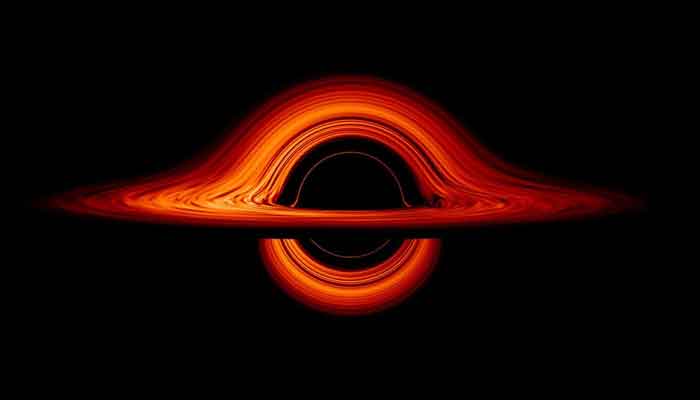
Scientists have predicted enigmatic space-time disruptions that occur, when two black holes pass close to one another, with greater accuracy than before.
Published in the journal Nature on Wednesday, May 14, the new research demonstrates the usefulness of abstract mathematical ideas from theoretical physics in simulating space-time ripples. This opens the door to more accurate models that can be used to interpret observational data, reported Space.com.
The motion of enormous objects such as neutron stars or black holes causes distortions in space-time known as gravitational waves. They were first directly observed in 2015, a century after they were initially predicted in Albert Einstein's general theory of relativity in 1915.
Since then, astronomers have used these waves as a potent observational tool to examine some of the most dramatic and mysterious phenomena in the cosmos.
Similar to predicting space weather, scientists require incredibly precise models of what those waves should look like in order to interpret the signals detected by sensitive detectors like Virgo and LIGO (the Laser Interferometer Gravitational-Wave Observatory).
Up until now, scientists have used potent supercomputers to model black hole interactions that necessitate gradually fine-tuning black hole trajectories — a method that is efficient but computationally costly and slow.
Now, a group from Berlin's Humboldt University, headed by Mathias Driesse, has adopted a different strategy.
The researchers concentrated on "scattering events" rather than mergers, which are situations where two black holes swirl near one another under their mutual gravitational pull before continuing on different paths without merging.
As the black holes race past one other, these collisions produce powerful gravitational wave signals.
The team employed quantum field theory, a subfield of physics that is commonly used to explain interactions between elementary particles, to accurately model these occurrences.
The researchers computed the main results of black hole flybys, including the amount of deflection, the amount of energy released as gravitational waves, and the amount of recoil the giants experienced following the encounter. They began by using basic estimates, then methodically building complexity.


-
 How dogs became man’s best friend 15,800 years ago: New study reveals
 -
 Real-life ‘Project Hail Mary’ moment: 45 planets that may support alien life discovered
 -
 CERN successfully transports antimatter for first time in historic breakthrough
 -
 Astronomers spot solar system lookalike 87 light-years away
 -
 From Moon base to nuclear spacecraft: Inside NASA’s strategic overhaul to win space race against China
 -
 Northern lights wane, but watch for midnight surprise to dazzle the sky
 -
 NASA, South Korea team up for L4 deep space exploration mission
 -
 Scientists use ‘Space Archaeology’ to rebuild hidden history of giant spiral galaxy