Brain implants let man control Amazon's Alexa with thought
ALS is a degenerative nerve disease that leads to muscle weakness and paralysis
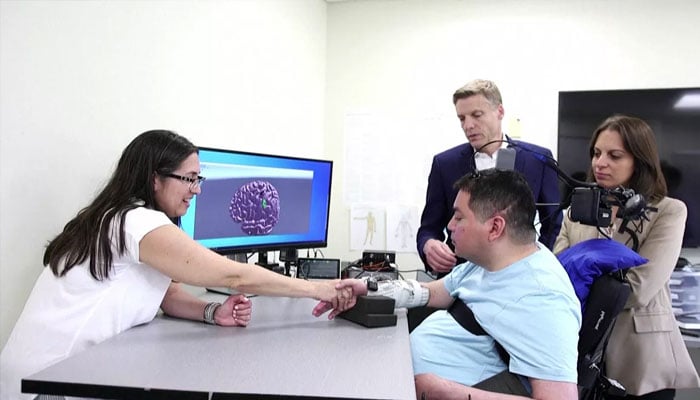
A patient with a degenerative disease can now control Amazon's Alexa digital assistant using only his thoughts, AFP reported.
This breakthrough technology allows him to stream shows and manage devices purely through mental commands.
The 64-year-old man has an implant in a blood vessel on the surface of his brain, which enables him to mentally "tap" icons on an Amazon Fire tablet, according to brain-computer interface company Synchron.
The patient, who is living with amyotrophic lateral sclerosis (ALS), was able to make video calls, play music, stream shows, control smart home devices such as lights, shop online, and read books by using his mind to direct Alexa, according to the New York-based company.
ALS is a degenerative nerve disease that leads to muscle weakness and paralysis.
"To be able to manage important aspects of my environment and control access to entertainment gives me back the independence that I'm losing," the patient, named Mark, said in a release.
The test was intended to show how customers could use just their minds to control smart homes with Alexa-compatible devices such as door cameras, plugs, and thermostats, according to the company.
"While many smart home systems rely on voice or touch, we are sending control signals directly from the brain," Synchron founder and chief executive Tom Oxley said in the release.
"Patients can interact with devices in their home hands and voice-free, using only their thoughts."
Several companies, including Elon Musk's Neuralink, are working on connecting brains with computers.
Neuralink in January installed a brain implant in a man paralyzed after a diving accident. Musk, who also owns Tesla and X, touted the implant as a success.
In July he said his startup is "moving on" to a second test patient as its tech improves.


-
 SpaceX Starship Flight 14 reaches orbit after successful insertion burn
 -
 Asteroid Bennu: NASA samples reveal how it was born from fire and ice
 -
 Harvard scientists detect mysterious radio signal from planet outside our solar system
 -
 Scientists may have found a way to grow food on Mars
 -
 Why Earth’s 24-hour day isn’t quite as fixed as you think
 -
 Earth is splitting apart beneath the Pacific Northwest: Here’s why
 -
 Google's AI Satellite Prototype Launches on SpaceX October 1
 -
 Google plans first AI chip test in space under project Suncatcher