Harvard scientists detect mysterious radio signal from planet outside our solar system
Scientists have successfully detected radio signals coming from an exoplanet for the first time ever
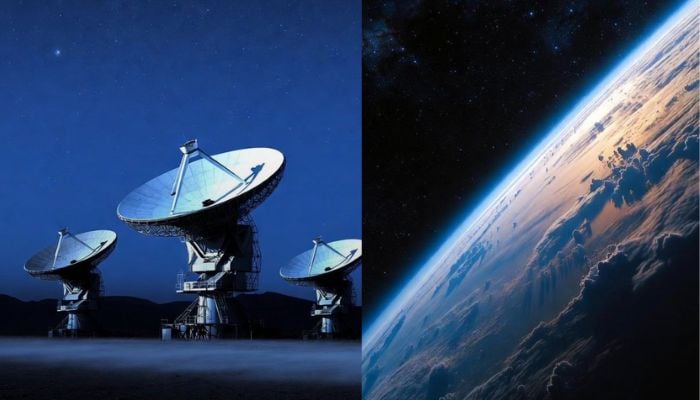
In a major breakthrough, astronomers have confirmed over 6,300 exoplanets circling host stars beyond our solar system, ranging from small, rocky worlds to luminous spheres of gas like our own Jupiter and Saturn.
According to some scientists, they could host life because they orbit their star in the habitable zone, a region where conditions are accurate for liquid water to exist on their surface.
It is challenging to get a clear view of these worlds because of the immeasurable distances, and distinguishing the signals radiating from these exoplanets from their far brighter host stars has also been a major barrier.
The planet called beta Pictoris b is a gas giant with a mass of over 11 Jupiters that takes over 23 Earth years to orbit its host year.
There is no sign that extraterrestrial civilization is somehow an atmospheric entity initiating contact; the radio emissions directly resemble an aurora, created by charged particles moving along the planet's magnetic field close to what we experience on Earth.
Researchers noted in their paper, “This constitutes the first direct measurement of magnetic field strength for an exoplanet, and is consistent with dynamo-scaling predictions for a young, massive giant planet.”
Nonetheless, the team managed to extract the signal from the exoplanet's host star Pictorias by using the known locations of quasars to ascertain its precise position. Quasars are extremely magnetized and active galactic nuclei at the centers of galaxies that are powered by supermassive black holes, and astronomers use them as cosmic lighthouses to determine the coordinates.


-
 Elon Musk’s Mars colonization dream faces reality check from Nobel laureate
 -
 NASA competition model 2.0 cuts mission selection by 45%
 -
 A ‘neglected’ neutrino may hold the key to why the Universe exists
 -
 Can cancer drugs be made in space? Here’s what the new mission aims to find out
 -
 SpaceX Falcon 9 successfully launches Bandwagon-5 mission with 32 payloads
 -
 Europe launched 8 orbital rockets last year, can it rival Starlink?
 -
 Japan launches world’s first mission to bring sample back from phobos
 -
 Orionid meteor shower 2026: Peak date, viewing tips and what to expect