
Galaxies from baby universe caught by JWST
Universe's earliest galaxies date back just 300 million years after Big Bang
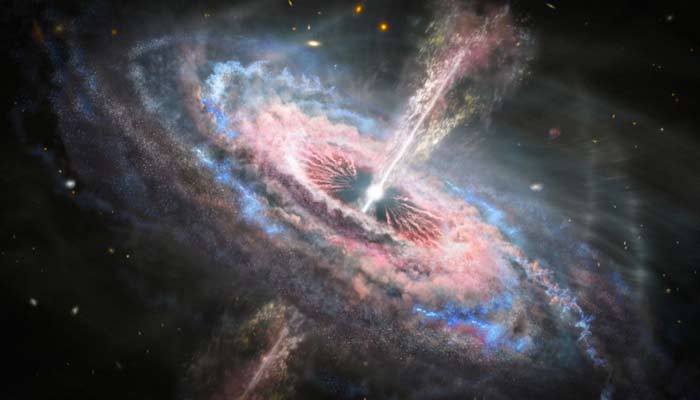
Dating back just 300 million years after the Big Bang, the James Webb Space Telescope has spotted the two earliest most distant galaxies in the universe, according to Live Science.
This new space search breaks the records set by another pair of galaxies, which were discovered by JWST last year. These galaxies roughly date back to 330 million years after the birth of the universe. They further push back our understanding of cosmic dawn even further.
Besides being exceptionally old, the newly discovered galaxies named JADES-GS-z14-0 and JADES-GS-z14-1 are also unusually large for such an early time in cosmic history in addition to being exceptionally old, according to the discovery paper published May 28 to the preprint server arXiv.
"It is stunning that the Universe can make such a galaxy in only 300 million years," lead study author Stefano Carniani, who is also an assistant professor at the Scuola Normale Superiore in Pisa, said in a statement.




-
 Climate change vs Nature: Is world near a potential ecological tipping point?
 -
 125-million-year-old dinosaur with never-before-seen spikes stuns scientists in China
 -
 Scientists stunned as shark appears for first time in Antarctic Southern Ocean waters
 -
 New study suggests universe can end in ‘Big Crunch’ in 20bn years
 -
 Hidden Venus: New data discovers massive underground Lava Tube
 -
 ‘Earth is defenseless against city-killer asteroids’: NASA issues stark warning
 -
 Annular solar eclipse 2026: Where and when to see the ‘Ring of fire’
 -
 Bright green comet C/2024 E1 nears closest approach before leaving solar system