
Will Pakistan witness first lunar eclipse of 2024 today?
Moon becomes 10% dimmer than its usual brightness, says Pakistan Meteorological Department
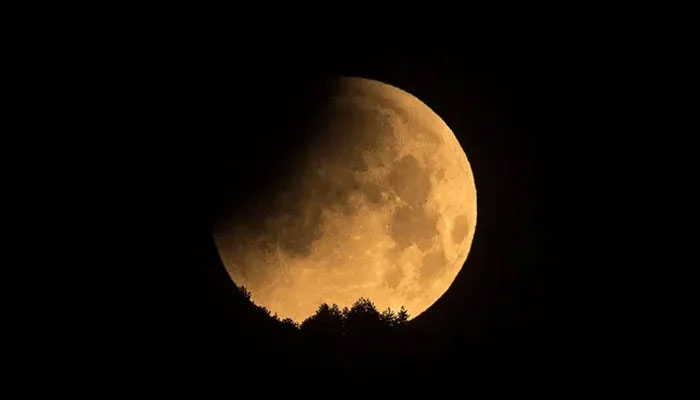
The first penumbral lunar eclipse of 2024 will occur today (Monday) with people in different parts of the world are expected to witness the unforgettable moments.
This lunar eclipse will come just weeks ahead of the most anticipated total solar eclipse of April 8.
The stunning cosmic event takes place when the Moon dips into Earth’s shadow, adding to the astronomical marvels.
In a penumbral eclipse, the Moon makes its way through the penumbra, which is the faint outer part of the Earth’s shadow, causing the Moon to dim very slightly.
During tonight’s eclipse, over 90% of the Moon will lie inside Earth’s penumbral shadow at its highest point, as per a report by Earth Sky.
However, this kind of eclipse is very hard to observe and many wouldn’t be able to spot any difference.
As per the Pakistan Meteorological Department (PMD), the Moon becomes 10% dimmer than its usual brightness.
The event coincides with Holi, the Hindu Festival of Colours, but won’t be visible in India or Pakistan, where it will begin at 9:53am, peak at 12:12pm and end at 2:32pm.
As per BBC’s Science Focus magazine, the eclipse will begin the night before, on 24 March 2024, for places six hours or more behind GMT, i.e. further west than Chicago.
The countries and regions expected to witness the spectacle include North and South America, parts of Ireland, Belgium, Spain, England, South Norway and Italy, Portugal, Russia, Germany, US, Japan, Switzerland, Netherlands and France.
As per NASA, the next lunar eclipse will be partial and will occur on September 18, 2024.
What is a lunar eclipse?
Lunar eclipses occur when the Earth positions itself between the Sun and the Moon and casts a shadow across the Moon's surface. They can only occur during a full Moon and make for an interesting skywatching target.
Types of lunar eclipse
It should be noted that there are three types of lunar eclipses depending on how the Sun, Earth and Moon are aligned at the time of the event.
Total lunar eclipse — Earth's shadow is cast across the entire lunar surface.
Partial lunar eclipse — Only part of the Moon enters Earth's shadow, which may look like it is taking a "bite" out of the lunar surface
Penumbral lunar eclipse — The faint outer part of Earth's shadow is cast across the lunar surface.


-
 Greenland ice sheet acts like ‘churning molten rock,’ scientists find
 -
 Space-based solar power could push the world beyond net zero: Here’s how
 -
 Hidden ‘dark galaxy' traced by ancient star clusters could rewrite the cosmic galaxy count
 -
 Astronauts face life threatening risk on Boeing Starliner, NASA says
 -
 Giant tortoise reintroduced to island after almost 200 years
 -
 Blood Falls in Antarctica? What causes the mysterious red waterfall hidden in ice
 -
 Scientists uncover surprising link between 2.7 million-year-old climate tipping point & human evolution
 -
 NASA takes next step towards Moon mission as Artemis II moves to launch pad operations following successful fuel test