
Sir Ian Wilmut, pioneering embryologist who cloned Dolly the sheep, dies at 79
Peter Mathieson, VC Edinburgh University, hailed Wilmut as "titan of the scientific world" who "transformed scientific thinking at the time" by cloning Dolly
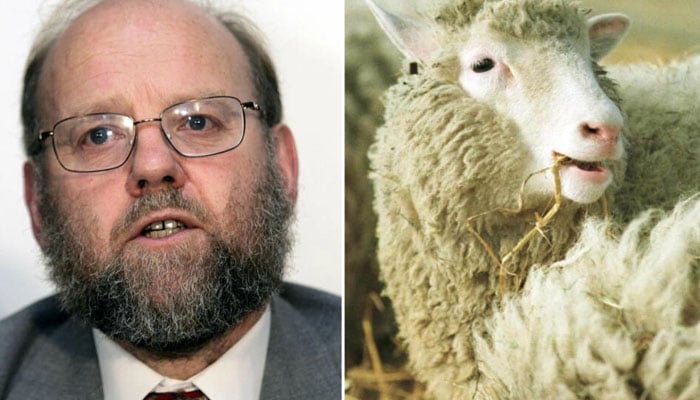
The British scientist who oversaw the team that successfully cloned Dolly the sheep has passed away at the age of 79, as per his old institution.
Ian Wilmut, who revealed in 2018 that he had been diagnosed with Parkinson´s disease, helmed the team at the Roslin Institute at the University of Edinburgh in Scotland, which cloned Dolly in 1996.
Dolly was the first mammal to be cloned from an adult cell, and the breakthrough garnered global headlines and led to new advances in animal and medical research.
Peter Mathieson, the vice-chancellor of Edinburgh University, hailed Wilmut as "a titan of the scientific world" whose work cloning Dolly "transformed scientific thinking at the time", AFP reported.
"This breakthrough continues to fuel many of the advances that have been made in the field of regenerative medicine that we see today," he said in a statement.
Bruce Whitelaw, the current head of the Roslin Institute, said it was "sad news".
"Science has lost a household name," he added.
Wilmut retired from Edinburgh University in 2012.
But in 2018, he announced support for new research into Parkinson´s, revealing he had been diagnosed with the uncurable, progressive brain disorder, which can cause uncontrollable movements such as shaking.
"There was a sense of clarity, well at least now we know and we can start doing things about it," Wilmut told the BBC at the time.
"As well as obviously the disappointment that it will possibly shorten my life slightly, and more particularly it will alter the quality of life."
Parkinson´s is the second most common neurodegenerative disease after Alzheimer´s and affects more than 8.5 million people worldwide, according to the World Health Organisation (WHO).



-
 Endless sunlight coming soon? Scientists say think twice
 -
 Mouse brain revival experiment sparks cryonics debate: Can humans be brought back to life?
 -
 NASA rover finds 4-billion-year-old flowing water evidence on Mars, raising hopes of past life
 -
 Meteor over Ohio causes powerful sonic boom heard as far as Pennsylvania
 -
 Australian scientists develop world’s first quantum battery in major energy storage breakthrough
 -
 NASA scientists capture brain-shaped Nebula around dying star in shocking discovery
 -
 Are humans living in simulation? Scientist reveals shocking evidence
 -
 Scientists discover strange ‘molten slush’ alien planet unlike any known world