G20 declaration: Here are five key takeaways from Bharat huddle
Modi opened G20 summit´s formal proceedings by inviting African Union President Azali Assoumani
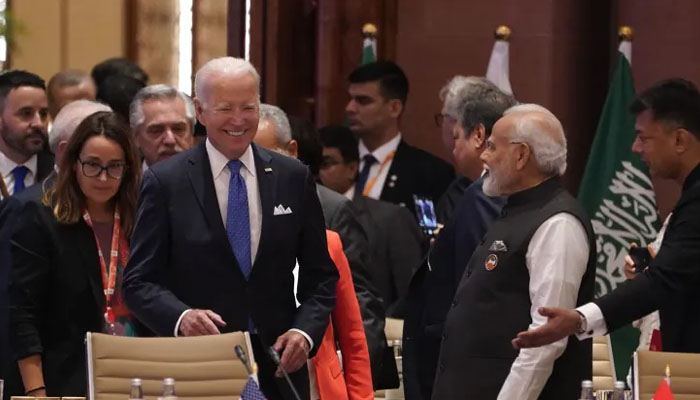
The G20 summit in New Delhi managed to defy expectations and reach an agreement on a single declaration by world leaders, despite the fact that there were some concessions made on the crisis in Ukraine and climate change action.
Here are the five defining moments of the summit so far:
And then there were 21
The Group of 20 leading economies began the weekend´s proceedings by welcoming the African Union, the newest member of a bloc that already represented 85% of world GDP.
Host and Indian Prime Minister Narendra Modi has portrayed this weekend as India's diplomatic coming of age, and his country's presidency as an opportunity to give a voice to the needs of the Global South, AFP reported.
Modi opened the summit´s formal proceedings by inviting African Union President Azali Assoumani to take a seat alongside world leaders with the ceremonial bang of a gavel.
Before Saturday, the G20 comprised 19 countries and the European Union, with South Africa its only member state from the continent.
The African Union at full strength has 55 members but six junta-ruled nations are currently suspended. It has a collective GDP of $3 trillion with some 1.4 billion people.
'Different views' on Ukraine
G20 leaders have been deeply riven over the Ukraine war since Moscow´s invasion last year, with Russian President Vladimir Putin skipping the summit entirely to dodge political opprobrium.
Facing the prospect of a major diplomatic embarrassment, host India pressed members to agree on a common statement that watered down its earlier condemnation of the war.
In the end, the G20 denounced the use of force for territorial gain but refrained from direct criticism of Russia by name.
"There were different views and assessments of the situation," the leaders' statement said.
Kyiv´s foreign ministry spokesman Oleg Nikolenko criticised the statement, saying the G20 had "nothing to be proud of".
Failure on climate
Leaders failed to agree on a phase-out of fossil fuels, despite a UN report a day earlier deeming the drawdown "indispensable" to achieving net-zero emissions.
G20 nations account for around 80% of global emissions and an inability to agree on the phase-out is a cloud over a key round of climate discussions to begin in November in the oil-rich United Arab Emirates.
"We need stronger bolder action from leaders," said Madhura Joshi, senior associate at climate think tank E3G.
But for the first time, the G20 backed a target of tripling global renewable energy capacity and referenced the need for emissions to peak before 2025.
It also acknowledged that limiting warming to 1.5 degrees Celsius will require slashing greenhouse gases by 43% by 2030 from 2019 levels.
'Real big' Middle East infrastructure
A broad alliance including the United States and Saudi Arabia unveiled ambitious plans to create a modern-day Spice Route linking Europe, the Middle East and India.
If the initiative goes ahead, it would establish railways, ports, electricity and data networks and hydrogen pipelines in a counterbalance to lavish Chinese infrastructure spending.
One proposed project would link rail and port facilities across the Middle East, potentially speeding up trade between India and Europe by up to 40%.
The plans are also being touted as a means of helping normalise relations between Israel and Gulf Arab states.
"This is a real big deal," said US President Joe Biden, locking arms with Modi and Saudi Crown Prince Mohammed bin Salman in a triple handshake.
India or Bharat?
For days India has been abuzz with rumours that official usage of the country's English name would be dropped.
Modi gave the biggest signal yet of a potential change in his opening address to the summit, seated behind a country nameplate labelled "Bharat".
India and Bharat are both official names for the country under its constitution.
Modi himself typically refers to the nation as "Bharat", a word steeped in Hindu religious symbolism and dating back to ancient scripture.
Members of his Hindu nationalist party have campaigned against using the better-known moniker India, which has roots in Western antiquity and was imposed during the British conquest.


-
 Kristi Noem hit by husband Bryon's cross-dressing photos after Corey Lewandowski 'affair'
 -
 Charlie Kirk killing: Bullet match confusion explained
 -
 Piers Morgan don't understand Scott Mills scandal
 -
 Why NASA Artemis II mission matters for Trump’s ‘America First’ vision
 -
 China moves to ban ‘bone ash apartments’ to regulate burial practices
 -
 Russia cracks down on VPNs as internet censorship tightens
 -
 Trump open to ending war without reopening Strait of Hormuz: Here’s why
 -
 Charlie Kirk case: Tyler Robinson’s lawyers request delay for preliminary hearing
-
 Charlie Kirk highway plan blocked by Arizona governor as political tensions flare over tribute bill
 -
Canada Post home delivery ends as losses force major shift to community mailboxes
-
Train derailment in St. Catharines causes transit disruption and road blockage in Niagara region
-
Air Canada employee charged over cannabis trafficking attempt at Toronto airport