
BRICS onboards 6 more members as China, Russia aim for greater influence
Although summit projected a facade of unity, there were differing opinions among BRICS members regarding the expansion
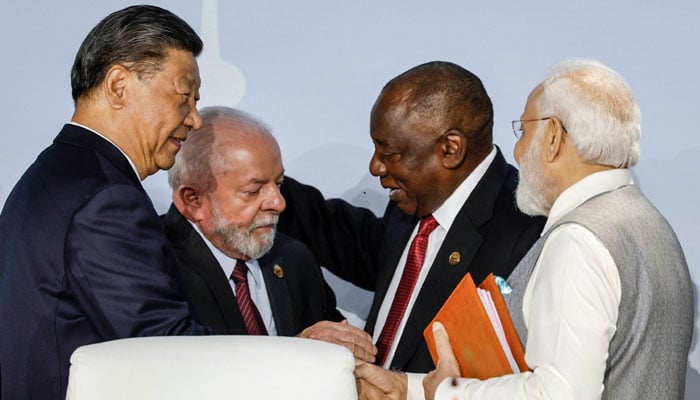
A group of emerging nations, known as the BRICS group, has extended invitations to Argentina, Egypt, Ethiopia, Iran, the United Arab Emirates, and Saudi Arabia, solidifying its position as a geopolitical alternative to Western-led international forums.
The announcement was made during a summit held in South Africa, as the BRICS group seeks to neutralise the influence of Western-dominated entities like the G7 and the World Bank.
With members like Brazil, Russia, India, China, and South Africa, the BRICS group collectively represents a quarter of the global economy and approximately 40 per cent of the world's population.
Differing opinions
Although the summit projected a facade of unity, there were differing opinions among BRICS members regarding the expansion. While some leaders cautioned against recreating the divisive global dynamics reminiscent of the Cold War era, concerns were raised about potential shifts in the group's dynamics and priorities.
India, in particular, wary of diluting its influence within the group, emphasized the importance of retaining its role, especially considering its ongoing territorial disputes with China. Similarly, Brazil and South Africa aimed to prevent estrangement from their European and North American partners.
The inclusion of Iran in the expansion raised eyebrows and indicated the influence of Russia and China in the decision-making process. This move was seen as potentially heightening geopolitical tensions with Western powers due to Iran's complex international relations.
Cold war-like dynamics
The BRICS group's stated goal of promoting diversity in an increasingly polarized world has become more pertinent in light of events such as Russia's actions in Ukraine and strained US-China relations.
Although there has been some speculation about the BRICS group evolving into a geopolitical rival to Western powers, US officials sought to downplay this possibility.
US downplays BRICS expansion
The Biden administration expressed its positive relations with existing BRICS members and reiterated its commitment to managing relationships with China and pushing back against Russian aggression.
China's President, Xi Jinping, who advocated for swift expansion, framed the inclusion of new members as a "historic" move. He emphasized the importance of international rules being collectively defined and upheld, rather than being dictated by the strongest players.
Indian Prime Minister Narendra Modi viewed the expansion as a signal for global institutions to adapt to changing times.
New entrants
For the countries invited to join, the implications varied. Saudi Arabia, a prominent trading partner of the BRICS group in the Middle East, has cultivated ties with China while maintaining a degree of independence from US interests.
Egypt, positioned between Africa and the Middle East, has developed strong relations with Russia and China while upholding its ties with the United States. Argentina, grappling with economic challenges, could potentially benefit from BRICS membership as it seeks alternative economic avenues.
Iran's application to join reflected its efforts to bolster connections with non-Western powers and counter Western isolation efforts. The United Arab Emirates, already part of the BRICS' New Development Bank, was also extended a formal invitation for membership.






-
 key details from Germany's multimillion-euro heist revealed
 -
 Search for Savannah Guthrie’s abducted mom enters unthinkable phase
 -
 Barack Obama addresses UFO mystery: Aliens are ‘real’ but debunks Area 51 conspiracy theories
 -
 Rosie O’Donnell secretly returned to US to test safety
 -
 'Harry Potter' star Rupert Grint shares where he stands politically
 -
 Drama outside Nancy Guthrie's home unfolds described as 'circus'
 -
 Marco Rubio sends message of unity to Europe
 -
 Hilarie Burton reveals Valentine's Day plans with Jeffrey Dean Morgan