
Praises Ehsaas programme: Rising current account deficit posing challenges to economy, says Pasha
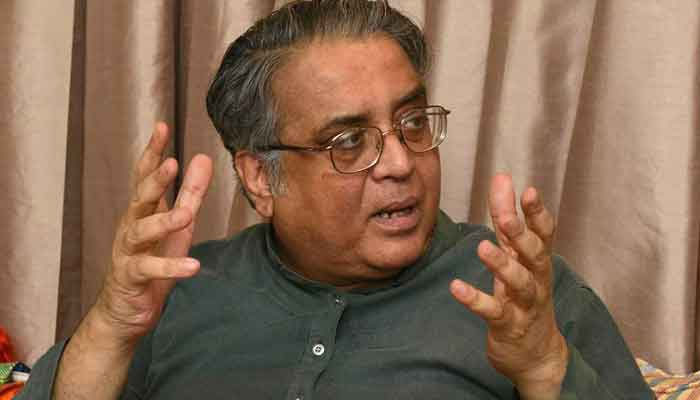
ISLAMABAD: Former finance minister Dr Hafiz Pasha has said that Pakistan’s economy was facing challenges on account of rising current account deficit, hiking inflation and increasing poverty as well as unemployment rate.
He termed the budgetary estimates highly “fragile”, so the budget deficit might exceed to 8 to 8.5 percent of GDP, equivalent to Rs4.5 trillion. The crowding out of private sector is possible, so the banks will not be in a position to lend money to small borrowers while the government planned to kick-start the Kamyab Jawan Program with an ambitious lending target of Rs1.6 trillion.
He said that 8.5 million people were unemployed in Pakistan at the moment, the highest-ever in the country’s history. The population below the poverty line stood at 38 percent in a post-COVID-19 pandemic.
He also alleged that the figures of CPI-based inflation were allegedly manipulated by the Pakistan Bureau of Statistics (PBS) that show decreased rate of inflation, saying that inflation was bound to increase and might be hovering into double digits in the range of 12 percent over a period of next six months.
“The current account deficit is projected to rise to $9 billion to $10 billion for the current fiscal year against projection of $2 billion estimated by the Planning Commission,” former finance minister Dr. Hafiz Pasha said in an interview with this scribe on Sunday.
He said that output prices of agriculture had gone up to 17 to 18 percent but input prices for farmers had increased by 40 percent, so profitability was destroyed. The share of farmers in formal credit had declined. Wheat production was over-exaggerated as production was not 27.2 million tons as the US Department of Agriculture had estimated its production at 26 million tons.
Dr Pasha said that the State Bank of Pakistan had projected a current account deficit hovering around 2 to 3 percent of GDP, equivalent to $6 to $9 billion. “It will depend upon how the prices of POL and other imports would remain and the current account deficit might be standing at $9 to $10 billion,” he added. He said that Pakistan had to repay over $40 billion in loans in the next three-year period. The government borrowed 34 percent on external loans and it is projected to get a 25 percent increase in the current fiscal year, he maintained.
He said the government was pursuing a strategy to build up reserves through increased lending before kick-starting talks with the IMF due in first week of September 2021. He said the IMF program would not end but it might be suspended in the wake of 4th wave of Covid-19 pandemic. However, the multilateral such as WB, ADB and IDB would not provide budgetary support, so efforts were underway to build up foreign exchange reserves. He said that the government was facing difficulty in implementing tough IMF conditions. The government is in catch-22 situation where it is difficult to take a decision whether to revive the IMF program or suspend the program.
He said that import liberalization was done more than the requirement. The import duties stood at 120 percent in the decade of 90s but now the highest import was just 20 percent. Pakistan is liberalized certainly more than India and other regional countries. Pakistan must extend protection on agriculture; our average tariff on agriculture products was 8 percent while India imposed 60 percent tariff on imported goods.
This kind of Additional Customs Duty and Regulatory Duty should be done away, so complete transparency must be adopted. There should be zero, 5, 15, 20 and 30 percent. There is massive under-invoicing going on and trade figures are available. There is need to compare prices with international prices, he added.
He said that sugarcane was not the right crop for Pakistan as he had introduced support price for cotton that got abandoned by the Musharraf regime. Now the government provided support price for cotton and withdraw support price on sugarcane.
He said that the palm oil prices went up by 50 percent and POL prices by 100 percent, so the current account deficit rose sharply to $1.6 billion alone in June 2021. He said that remittances went up by 30 percent but rate of increase decreased to 10 percent in June 2021. The remittances from Saudi Arabia dropped by 8 percent. The travelling restrictions were being lifted, so there were chances that the remittances might drop by $3 billion. There is a need to undertake efforts for keeping remittances around $30 billion, he added. He said that the volume of textile exports had decreased but prices increased. There was no investment made in textile but the investment went up because of the SBP’s policies.
The services sector, he said, was achieving a breakthrough but he was surprised that the government-imposed tax on digital services. He said that real living standard had declined in Pakistan. He praised the Ehsaas program and hoped that it would provide support to 20 million people. He said that the poverty level in Pakistan stood at 38 percent in 2012-13 on the basis of Cost of Basic Needs (CBN). The poverty declined to 30 percent in 2017-18 because of higher growth and low food prices. Now again the poverty level rose to 38 percent again, he added. The unemployment rate in Pakistan became 8 to 8.5 million, which is the highest level of unemployment. He said that the bottom up approach was rightful thinking but its implementation required careful handling. He said that there was a need to provide financing to SMEs instead of individual loans. He proposed Credit Guarantee Scheme for providing financing to SMEs in Pakistan. There are no incentives to banks to provide loans to small borrowers. He said that the current fiscal year budget was most fragile budget as revenues were understated and expenditures overstated. There is no need of over-confidence on FBR’s collection because imports resulted into higher collection in July 2021, he added. The real test is current account deficit, he said and added that it possessed risks that need to be curtailed. He said that the amnesty on investment was wrong so construction did not really pick up. There should be no tax amnesty scheme in principle, he added. Inflation might go up to 12 percent while 8 percent was wrong, he concluded.







-
 Changes Made To King Charles’ Official Role: Report
 -
 Footballer Héctor Bello Pays Tribute To Wife Who Died In Venezuela Earthquakes
 -
 Trump Administration Likely To Unblock Anthropic Fable 5 Soon
 -
 Nancy Guthrie Update: Hoda Kotb Put On Standby As Savannah Leaves ‘everyone Deeply Worried’
 -
 Taylor Swift, Travis Kelce Wedding: Street Closures Spark Backlash
 -
 King Charles Honours Local Heroes In Inspiring Parliament Speech
 -
 Scientists Find Ancient Microbial Life In Places It Shouldn't Exist
 -
 Ellen DeGeneres Faces New Backlash After Winning Battle Over English Estate
 -
 After Bill Gates Testimony, New Report Takes Lid Off Sarah Ferguson’s Secret Visits To Epstein
 -
 IPhone 18 Rumors: Everything You Need To Know
 -
 'The Bear' Ends With Heartbreaking Tribute To Rob Reiner
 -
 Prince Harry Bracing For 'nothing' Under King William's Reign
 -
 Madonna Recalls Being 'constantly' Kicked Out Of Homes Before Fame
 -
 Kate Middleton Surprises Royal Fans As She Steps Out With Prince George
 -
 Australian Man Arrested In Thailand Following Discovery Of 17-year-old’s Body In Suitcase
 -
 Ex-UK Prime Minister Attacks FIFA Over Exploiting Fans