
Rafale vs J-10C: battle of 4.5-gen fighters
Rafale’s downing also proves that PAF’s focus shift from platform alone to efficacy of entire kill chain -- radar, data links
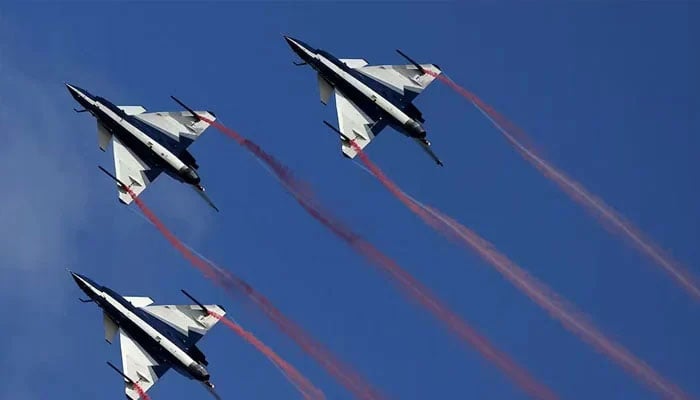
Between 1:05am and 1:30am on May 7, the Pakistan Air Force (PAF) accomplished a historic milestone in modern air warfare. In a first for any air force globally, the PAF successfully engaged and shot down a 4.5-generation multirole fighter aircraft — the French-built Dassault Rafale — marking the platform’s first confirmed combat loss.
The downing of a Rafale -- valued at approximately $120 million -- by a J-10C, which costs nearly a third at $40 million, marks far more than a mere tactical engagement. It represents a pivotal inflection point signaling the evolution of military aviation technology. For Pakistan, it constitutes a strategic triumph. For India, it demands a serious moment of doctrinal introspection. And for the global defence community, it is a stark indicator that the mantle of air superiority may no longer rest solely with Western aerospace powers.
The following day, shares of Dassault Aviation, listed on the Euronext Paris under the ticker symbol AM.PA, fell by 6.0 per cent. While defence equities typically respond to long-term procurement cycles and government contract flows, such a sharp intraday decline, driven by concerns over combat performance, is highly unusual and reflects a notable erosion of investor confidence.
Conversely, shares of Aviation Industry Corporation of China (AVIC), the manufacturer of the J-10C, surged by an impressive 38 per cent on the Shenzhen Stock Exchange (ticker: 302132.SZ). The market reaction suggests a strong vote of confidence in AVIC’s airpower platforms, likely fueled by the J-10C’s validated performance in a high-intensity combat environment.
Imagine, for the first time ever, a Chinese-origin platform has neutralised a Western flagship fighter in a real-world engagement. Yes, that means Western air superiority is vulnerable. Yes, that also means that China’s airpower is now combat-proven on the global stage.
Imagine, $2 million Rafale’s advanced Meteor missile was tactically outmanoeuvred by the $1 million Chinese PL-15. Does this suggest the first-to-lock-first-to-kill doctrine is more decisive than platform agility or stealth in many engagements?
The Rafale’s downing also proves that PAF’s focus shift from the platform alone to the efficacy of the entire kill chain -- radar, data links, missiles and doctrine -- is yielding strategic dividends in modern air combat.
Yes, India’s air dominance strategy lies exposed. Yes, the downing of a Rafale fighter -- the crown jewel of the Indian Air Force -- is a strategic embarrassment that lays bare the flaws in India’s airpower doctrine. For a platform that cost over $120 million per unit, equipped with advanced sensors, electronic warfare suites, and the much-vaunted Meteor missile, to be neutralised in a contested environment raises damning questions.The apparent inability of Rafale’s SPECTRA suite to evade or jam the threat environment raises urgent questions about IAF survivability in future high-end conflicts. Will this incident prompt the IAF toward unmanned combat systems and force dispersion to reduce vulnerability? Clearly, IAF structures lag behind modern peer standards.
The downing of a Rafale by a J-10C will do three things: legitimise the J-10C as a credible competitor to Western jets like the Rafale, Eurofighter Typhoon, and F-16V; reshape fighter acquisition preferences in developing countries; and boost Chinese defence exports.
The future of modern air combat will be dominated by stand-off weapons. Equally significant, the PAF’s doctrine of network-centric warfare has proven its effectiveness, integrating sensors, shooters, and communication networks into a unified, responsive combat system. The most important lesson from the J-10C’s encounter with the Rafale is clear: superiority in the kill chain -- rather than just platform pedigree -- determines victory.
Amid this high-stakes encounter, three things cannot be overlooked: the exceptional training of PAF pilots; their tactical finesse and their mastery of modern aerial combat. PAF pilots combined classroom precision with combat intuition, multi-domain coordination, network-centric warfare and high-G manoeuvring. To be sure, this is not just a victory of hardware over hardware; it is a testament to the human edge that PAF pilots consistently bring to the battle space. Yes, it was skill, split-second judgment, and situational awareness that tipped the balance in Pakistan’s favour.


