
News Analysis: The 87-hour war: $1 billion an hour
India also deployed unmanned aerial systems between May 7 and May 10 to probe and identify Pakistan’s air defence architecture
AT precisely 1:05am on May 7, the Indian Air Force (IAF) initiated Operation Sindoor — a 23-minute strike targeting nine civilian locations inside Pakistan. The IAF’s primary strike platform was the Dassault Rafale fighter jet, equipped with SCALP EG (Storm Shadow) air-launched cruise missiles, capable of striking targets over a range of approximately 550 kilometres, and AASM Hammer precision-guided glide bombs.
India also deployed unmanned aerial systems between May 7 and May 10 to probe and identify Pakistan’s air defence architecture. These included the Indo-Israeli SkyStriker loitering munitions and the Israeli-made Harop drones -- both used not only for targeting but also to trigger and map out radar and surface-to-air missile responses, in an attempt to expose gaps and vulnerabilities in Pakistan’s integrated air defence network.
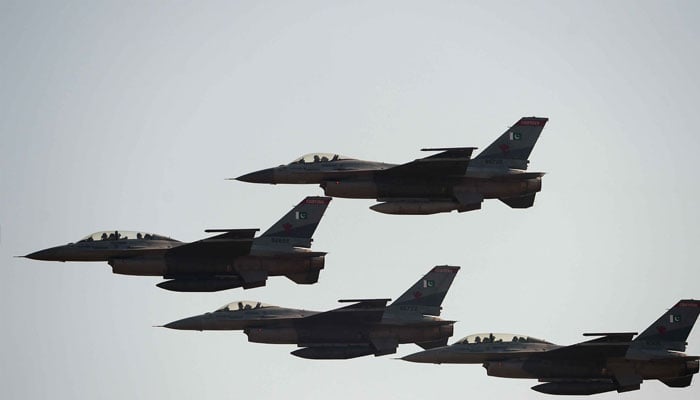
From May 7 to May 10, Pakistan launched a comprehensive military response to India’s Operation Sindoor, engaging its air force, army, and missile units. The Pakistan Air Force (PAF) deployed the Chengdu J-10C as its primary multirole fighter, equipped with PL-15 beyond-visual-range air-to-air missiles (BVRAAMs) and supported by KORAL electronic countermeasures (ECM) systems for enhanced electronic warfare capabilities.
Between 1:05am and 1:30am on May 7, the Pakistan Air Force (PAF) achieved a historic milestone in modern aerial warfare. In a global first, the PAF successfully engaged and destroyed three French-built Dassault Rafale 4.5-generation multirole fighters, marking the platform’s first confirmed combat losses. Pakistan also claimed to have downed 12 Indian drones using a combination of electronic countermeasures (ECM), anti-aircraft artillery (AAA) and short-range surface-to-air missiles.
Between May 7 and May 10, spanning 87 hours and 25 minutes, India’s NIFTY 50 and BSE Sensex, the country’s flagship stock market indices, lost a combined $82 billion in market capitalization. Airspace closures in northern India resulted in commercial aviation losses of about $8 million per day. The suspension of the Indian Premier League (IPL) led to losses of $50 million from television rights, ticket sales, and advertising. Military operations cost an estimated $100 million, while the loss of jets amounted to $400 million. Trade disruptions, including delayed cargo and logistics, caused $2 billion in losses, alongside unquantified impacts from diminished investor confidence and foreign direct investment (FDI). The total cost of the conflict to India is estimated at approximately $83 billion. Between May 7 and May 10, spanning approximately 87 hours and 25 minutes, Pakistan’s KSE-100 index fell 4.1 per cent, losing roughly $2.5 billion in market capitalisation. The suspension of the Pakistan Super League (PSL) resulted in $10 million in losses from broadcasting and related revenue. Airspace closures caused commercial aviation losses of approximately $20 million.
Military operations cost an estimated $25 million per day. Drone and missile operations, involving Bayraktar TB2s and Ra’ad air-launched cruise missiles (ALCMs), amounted to $300 million. The loss of investor confidence FDI had a moderate chilling effect, though unquantified. The total cost of the conflict to Pakistan is estimated at approximately $4 billion.
The 87-hour war was not just fought in the skies—it ripped through stock markets, grounded economies, and shattered illusions of invincibility. At a staggering cost of $1 billion per hour, it exposed the fragility beneath imaginary superpower hubris. At a staggering cost of $1 billion per hour, the war proved that in modern warfare the true price is measured not just in fighter jets, missiles and drones -- but in stock markets, currency devaluation, disrupted supply chains, commercial aviation losses and fleeing foreign investment.


