The people asked, “O Allah’s Apostle (S.A.W), how shall we (ask Allah to) send blessings on you?”

BITS ‘N’ PIECES
Narrated Abu Humaid As-Sa’idi (R.A):
The people asked, “O Allah’s Apostle (S.A.W), how shall we (ask Allah to) send blessings on you?” Allah’s Apostle replied, “Say: O Allah! Send your mercy on Muhammad and on his wives and on his off spring, as you sent your mercy on Abraham’s family; and send
your blessings on Muhammad and on his offspring, as you sent your blessings on Abraham’s family, for you are the most praise-worthy, the most glorious.”
Sahih Bukhari, Volume 4, Book 55, Number 588
Three scientists have won the Nobel Prize in Chemistry for developing Harry Potter-like materials.
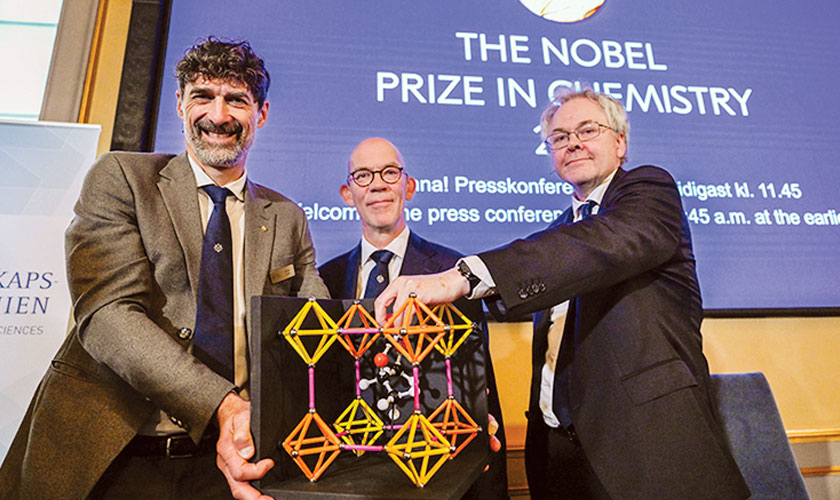
Three scientists who developed materials reminiscent of something from Harry Potter have been awarded the 2025 Nobel Prize in Chemistry. Susumu Kitagawa of Kyoto University (Japan), Richard Robson of the University of Melbourne (Australia), and Omar M. Yaghi of the University of California, Berkeley (USA), received the honour for their pioneering work on metal-organic frameworks (MOFs).
These innovative materials can store large amounts of gas in a very small space, “almost like Hermione’s handbag in Harry Potter,” explained Heiner Linke, chair of the Nobel Committee for Chemistry. In the series, Hermione’s magical bag can hold far more objects than its size suggests, a concept mirrored by the extraordinary storage capacity of these frameworks.
Unlike the fictional handbag, however, MOFs obey the laws of physics. They are made of metal ions connected by long organic molecules, forming crystalline structures with spacious cavities that can trap and store gases. The Royal Swedish Academy of Sciences announced the award on 8 October in Stockholm. It marks the 117th Nobel Prize in Chemistry and comes with a cash reward of 11 million Swedish kronor (£830,000).
“I’m deeply honoured that my long-standing research has been recognised,” said Kitagawa, noting that the most promising use of these frameworks lies in separating elements from air - such as carbon dioxide, oxygen, and water - for sustainable applications.
The foundations of this breakthrough date back to 1989, when Robson linked copper atoms with a four-armed molecule to create a crystal filled with tiny compartments. Between 1992 and 2003, Yaghi and Kitagawa advanced the research, proving that gases could flow in and out of these frameworks while improving their flexibility, stability, and customisable features.
Since then, scientists have developed countless MOFs with wide-ranging uses, from capturing toxic gases for semiconductor manufacturing to harvesting water from desert air, catalysing reactions, and breaking down pollutants, including stubborn ‘forever chemicals’.
Their most significant potential, however, lies in combating climate change. MOFs are now being tested to capture carbon dioxide emitted by factories and power plants, a step that could make Kitagawa’s dream of “capturing air and converting it into useful materials” a reality.