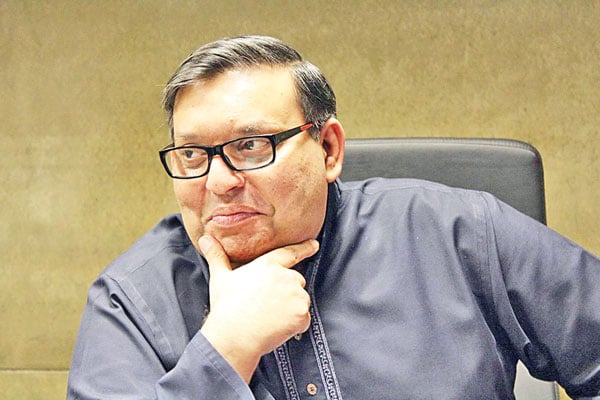
“What does one achieve after an accident?” Nadeem Mandviwalla, film distributor and owner Atrium cinemas, candidly stated, in a candid conversation regarding the future of cinema in Pakistan. “Accidents just happen; you can’t look for advantages or benefits in them. They’re unfortunate. The government had not given any directives to take Indian movies down (after Uri) but it was the need of the moment, given the hostility. It’s what the people wanted. Temperatures have now cooled down and sanity has prevailed.”
Freaky Ali, starring Nawazuddin Siddiqui, Arbaaz Khan and Amy Jackson is written and directed by Sohail Khan. It is the comeback film, which had already been imported and screened in early September. It’s a start, a gentle declaration of the end of the suspension.
culturevulture
Nadeem Mandviwalla talks to Instep about the latest development in the Bollywood suspension saga.
What did we achieve by suspending the screening of Indian films in Pakistani cinemas for an odd three months?
“What does one achieve after an accident?” Nadeem Mandviwalla, film distributor and owner Atrium cinemas, candidly stated, in a candid conversation regarding the future of cinema in Pakistan. “Accidents just happen; you can’t look for advantages or benefits in them. They’re unfortunate. The government had not given any directives to take Indian movies down (after Uri) but it was the need of the moment, given the hostility. It’s what the people wanted. Temperatures have now cooled down and sanity has prevailed.”
Indian films are back in Pakistani cinemas, three months after Uri and the subsequent ban on Bollywood films from being screened this side of the border. Freaky Ali is the comeback film, which had already been imported and screened in early September. It’s a start, a gentle declaration of the end of the suspension.
“Films that had already been imported will be screened as a token,” confirmed Nadeem Mandviwalla.
Social media gave a mixed reaction, with most people welcoming the motion while others, playing on patriotism, objecting to it. The biggest objection being that India has not yet opened its gateway to Pakistani films and even Pakistani dramas, formerly running successfully on Zee Zindagi channel, are still in suspension across the border. One cannot say whether our artists will be able to work in Bollywood anymore, especially not any time soon.
“Only time will tell what course this situation will take,” he explained. “You have to understand that there was no intimidation or public agitation over screening Indian films in Pakistan. Our behavior was reactionary. But there was and continues to be a serious threat to filmmakers in India.”
“This whole situation has been more counterproductive for India than Pakistan,” he continued. “The Indian stance will be highlighted in international markets; these things have a long lasting impact on trade development.”
The fact that the government of India has been ineffective in controlling the situation, allowing the MNS to bully filmmakers and actors in the Maharashtra province, has raised eyebrows. Of course, the educated opinion is that the MNS is acting with the silent blessings of the Modi government. Did Mandviwalla feel that industry stalwarts like Karan Johar and Shah Rukh Khan had fallen from grace for bowing to Raj Thackeray?
“This was their survival,” he said. “You can’t fall from grace if you’re trying to save yourself from terrorism. Anyone with stakes as high as Shah Rukh Khan or Karan Johar would have done the same. Om Puri could speak his mind because he had nothing at stake.”
Mandviwalla added that the screening of Freaky Ali was a tester, the beginning of a conversation, which would undoubtedly have many twists and turns. However, the larger picture needs to be kept in priority and that larger picture is rebuilding our own film industry.
“To shut cinemas down for three months is no joke,” Mandviwalla said. We have unofficial numbers to show the extent to the damage. Cinema footfall had decreased by 60% affecting the viewership of Pakistani films. 1700 cinema employees were reportedly fired in November. 40% multiplex screens were closed due to lack of content and so on. “Cinemas have been suffering for the last 40 years. So far only 10% of the industry has been revived. We cannot stand on our feet yet. When 90% of our industry is revived only then will we be able to say that we don’t need Indian films.”
To reintroduce Indian films back into cinemas is the only way to ensure that the revival of Pakistan’s film industry does not come to an abrupt halt. And if things continue to cool down and no further border tensions erupt, then it looks like we may be able to watch Raees on the big screen in Pakistan after all. But does Nadeem Mandviwalla think our artists will be able to work in India any time soon?
“They hadn’t worked there in forty years,” he laughed. “It doesn’t really matter.”