Astronomers find most distant fast radio burst ever recorded
Researchers believe when the burst was produced, there was no Earth, there was no sun
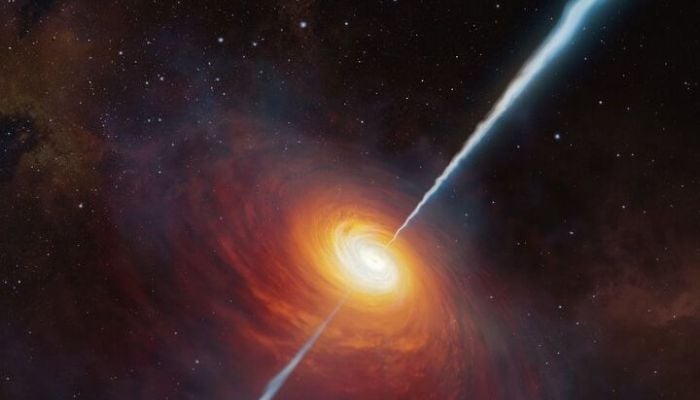
Astronomers in a recent breakthrough have detected the most distant burst of radio waves that travelled more than 10 years before reaching Earth.
The researchers believe that this fast radio burst (FRB) was released from a really faraway galaxy into the universe a very long time ago.
According to new research published in the journal Science, the researchers found that the FRB 20240304B originated from a small galaxy filled with many young stars.
At the time of release, the universe was only one-fifth of its current age, around 3 billion years old, and the burst spanned around 80 percent of cosmic history.
The burst was initially detected by the MeerKAT radio telescope in South Africa, and its host galaxy was subsequently identified using NASA’s James Webb Space Telescope (JWST).
JWST data revealed that the burst originated from a young, very small, metal-poor galaxy that was forming stars at a very high speed.
While theories include magnetars such as neutron stars with powerful magnetic fields, the exact mechanism remains unproven, and whatever causes them must account for their ability to form in young, low-metal environments.
Dr Themiya Nanayakkara of the University of Sydney, one of the lead researchers on the paper, said “when the burst was produced, there was no Earth, there was no sun.”
“Whatever the mechanism that causes this radio burst has to account for the fact that it can be produced in … very young galaxies with very low amounts of metals,” Nanayakkara said.
Since 2007, astronomers have detected more than 10,000 FRBs. But for them they still remain a mystery as the researchers have been trying to unravel them for two decades.
As this particular burst has been travelling for 80 percent of the age of the universe, it could help scientists to map and decode unseen matter in the distant universe.


-
 Draconid meteor shower tonight: Best time and places to see it
 -
 ‘A dream for 50 years’: Why world’s first nuclear clock could change timekeeping
 -
 NASA Curiosity captures strange ‘wind-carved’ Mars landscape in dawn image
 -
 NASA's Crew-12 Dragon begins return trip from space station
 -
 Mysterious ‘phoenix planet’ found around the remains of a dying star
 -
 First possible evidence of Planet Nine found in infrared data
 -
 Elon Musk announces SpaceXAI rebrand to SpaceXSI following presidential order on 'Super Intelligence'
 -
 ISS Command changes hands in emotional ceremony