Flood alert: Border lake overflows days after devastating Nepal-Tibet glacier collapse, over 480 dead, hundreds remain missing
Emergency authorities issue high-level evacuation orders as swelling barrier lakes and unstable upstream debris threaten a secondary disaster
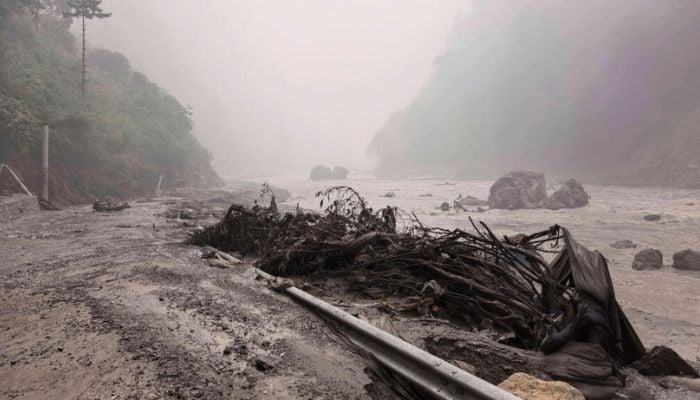
A catastrophic natural disaster struck the Nepal-Tibet border along the Lhende Khola and Bhote Koshi/Trishuli river systems.
What initially baffled officials as a potential earthquake-triggered event was confirmed by the US Geological Survey (USGS) to be a massive high-altitude glacial collapse and debris flow (registering a magnitude-equivalent of 5.2).
A massive chunk of ice and rock plunged roughly 1,200 meters into the valley below, displacing river water and generating an unstoppable wall of mud, boulders, and water.
The death toll has tragically climbed to at least 469 people in Nepal, with hundreds more casualties and missing persons reported on the Tibetan side.
Over 1,300 people remain missing in Nepal, alongside hundreds missing in Tibet. The missing include a significant number of foreign tourists, trekkers, and pilgrims (spanning Indian nationals visiting Mount Kailash, US, British, Australian, and Canadian citizens).
As reported by the Guardian, Dozens of bridges, critical hydropower plants, communication networks, and roughly 40 kilometers of roads have been completely obliterated. Gyirong Port, a vital land crossing between Tibet and Nepal, was severely crippled.
The situation remains volatile, triggering urgent secondary alerts.
The colossal number of sliding debris temporarily blocked river channels, creating unstable artificial barrier lakes (such as near the confluence in the Rasuwa district/Tibet border region). These lakes have been rapidly accumulating millions of cubic meters of water.
Moreover, rescue operations in Nepal has been temporarily halted as authorities in Nepal and China have repeatedly had to suspend helicopter and ground rescue operations due to immediate overflow risks and fresh dam-burst warnings.
Nepal Police and disaster management authorities have issued high alerts, urging residents and remaining rescue personnel along the Bhote Koshi and Trishuli river corridors to immediately evacuate to higher ground as water levels surge unexpectedly.
International humanitarian aid and emergency response teams are racing against time, but relief efforts remain heavily constrained by destroyed terrain and the constant threat of secondary flash floods.


-
 Beluga whale Cyprus dies in California months after leaving Ontario's Marineland
 -
 Australian employers using AI to track workers without their knowledge, report warns
 -
 UK hits back at Hegseth after he questions NATO allies' sacrifices in Afghanistan
 -
 US Supreme Court refuses to restore plea deals for three alleged 9/11 conspirators
 -
 ICE agents accused of using force against US citizen in Long Beach
 -
 Trump is using presidency to make himself richer, say majority Americans in new poll
 -
 Helen Haines, former nurse turned Australian MP critically injured in suspected attack
 -
 Meta admits mistaken suspension of 'No Kings' Instagram account, cites Claude AI glitch
-
 Playing loud music in public transport in UK can lead to £100 fines under new crackdown
 -
French PM calls for partial curfews as nationwide riots and protests escalate
-
Could Putin, Trump and Xi meet to discuss Ukraine? Kremlin responds
-
Putin approves major Russian government reshuffle following parliamentary elections