Elon Musk’s xAI launches world’s first Gigawatt AI supercluster to rival OpenAI and Anthropic
xAI officially launched Colossus 2, achieving a historic milestone as the first gigawatt-scale AI supercluster
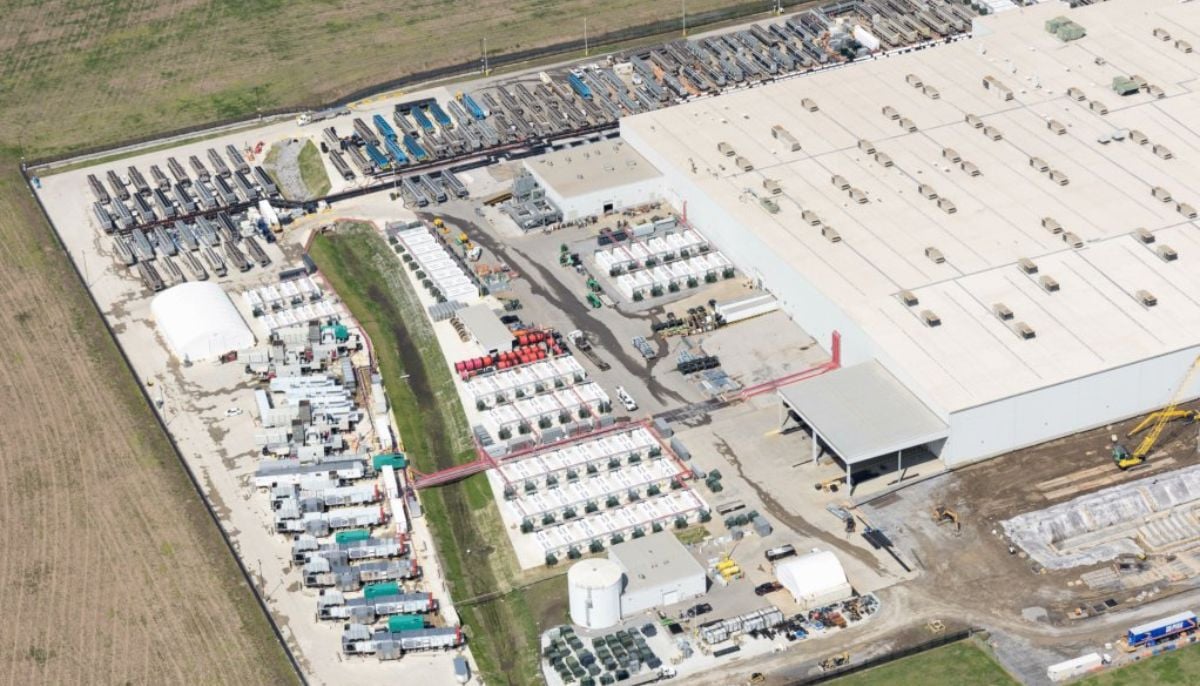
Elon Musk’s xAI unveiled Colossus 2 on Friday, marking a significant breakthrough as the world’s first gigawatt-scale (GW) AI training supercluster. This move outpaces rivals like OpenAI and Anthropic, who are reportedly facing delays until 2027 or later.
The prime motive behind this project is to provide massive computational power required to train the next generation AI, particularly Grok 4.
Constructed in record time using on-site gas turbines and Tesla Megapacks, the cluster’s current draw matches San Francisco’s peak electricity demand; furthermore xAI plans to reach a 1.5-gigawatt capacity by April.
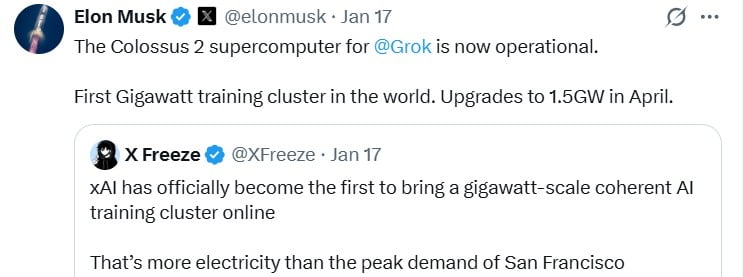
The immediate rollout receives praise from Nvidia’s CEO but criticism from activists over pollution in South Memphis neighbourhoods.
Competitors are still drafting strategic planning for 2027, xAI is already operating at major-city level power today.
The execution speed is unreal as below:
- Colossus 1-from first to fully operational in 122 days
- Colossus2-just incredibly crossed the 1GW barrier, targeting 2GW total
Elon’s playbook has not completely transformed but it has moved faster than anyone else’s, the strategy is clear and execution at scale. The launch of Colossus 2 marks a significant milestone in the era of compute, setting a new record for hardware density and the way AI companies interact with energy grids and the environment.


-
 Block’s Dessa AI voice model learned to talk without text: Here’s how
 -
 Sam Altman says AI is finding ‘Insane’ hardware-level bugs we never expected
 -
 iPhone Duo screen cracks after just six hours, users report
 -
 AI decodes Napoleon's cipher after 217 years in 6 hours
 -
 3 settings to stop Google personalised ads from Gmail data
 -
 Jack Dorsey’s Block launches Dessa AI voice model, but users aren’t happy
 -
 Moonshot AI restricts open-weight hacking ability in new Kimi model as fears grow over AI-powered cyberattacks
 -
 WhatsApp tests new filter to find mentions, replies faster