James Webb Telescope discovers new Moon orbiting Uranus: Everything we know
New moon, S/2025 U1, orbiting just 35,000 miles icy Uranus, the seventh planet from the sun
A newly found tiny celestial body is making waves in the astronomy world.
Astronomers using NASA’s James Webb Space Telescope have discovered a new moon, S/2025 U1, orbiting just 35,000 miles icy Uranus, the seventh planet from the sun.
Though, for now, astronomy lovers are keeping an eye on it as it awaits its official name.
Discovery details here:
James Webb Space Telescope turned the tables on!
The moon, known as S/2025 U1, is roughly 6 miles (10 kilometers) in diameter, which made it invisible to NASA’s Voyager 2 probe during its 1986 flyby of the planet, as well as rendering it invisible by other telescopes.
But then came the powerful James Webb Space Telescope (JWST).
How Scientists found the new moon?
A team of scientists at the Southwest Research Institute (SwRI) in Colorado, made 10 various 40-minute exposures of Uranus using JWST’s Near-Infrared Camera (NIRCam) in order to find the small moon.
Its discovery brings the total number of known Uranian moons to 29.
Matthew Tiscareno, a member of the research team at SETI institute in Mountain View California, stressed that Uranus has the largest small inner moons as compared to any other planet: “No other planet has as many small inner moons as Uranus, and their complex inter-relationships with the rings hint at a chaotic history that blurs the boundary between a ring system and a system of moons.”
He continued, “The new moon is smaller and much fainter than the smallest of the previously known inner moons, making it likely that even more complexity remains to be discovered.
Tiny newcomer joins Uranus’ moon family
The new moon is the 14th member of the intricate system of small moons orbiting inward of the largest moons Miranda, Ariel, Umbriel, Titania, and Oberon.
Interestingly, all the moons of Uranus are named after characters from Shakespeare and Alexander Pope.
New Moon’s location revealed
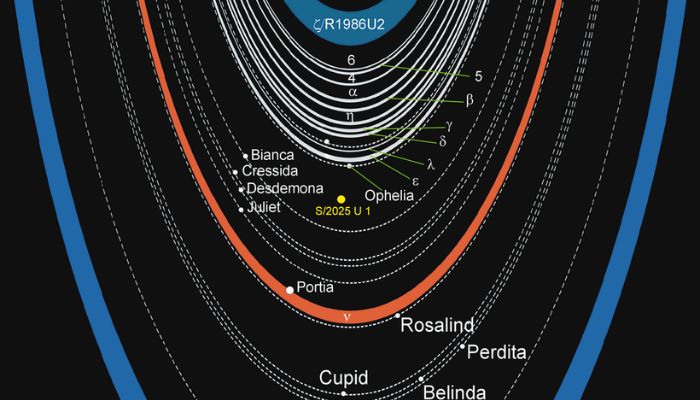
The moon, S/2025 U1, is located 35,000 miles from Uranus’ center, orbiting the planet’s equatorial plane between the orbits of Ophelia (which is just outside of Uranus’ main ring system) and Bianca.

Who will approve new name for the new moon?
A name for the newly found moon will have to be approved by the International Astronomical Union (IAU), the leading authority in assigning official names and designations to astronomical objects.


-
 Luke Combs knew his 2016 song would make him superstar
 -
 Adele to perform on major celebrity's milestone birthday in November
 -
 'Harry Potter' star John Lithgow shares his two cents on J.K. Rowling's controversy
 -
 Britney Spears 'swears to clear the slate' as fears grow after DUI arrest
 -
 Ozzy Osbourne's daughter Kelly drops ice-cold message for ex-fiancé Slipknot DJ Sid Wilson
 -
 Netflix surprises Gordon Ramsay with special gift for his 60th birthday: 'It's absolutely huge'
 -
 Alison Hammond gushes over younger boyfriend in candid confession
 -
 'The Young and the Restless' star Dee Freeman passes away at 66