
'Let’s break it down' World Hepatitis Day 2025 - what you need to know
Everyday 6000 people are infected with hepatitis, reports WHO
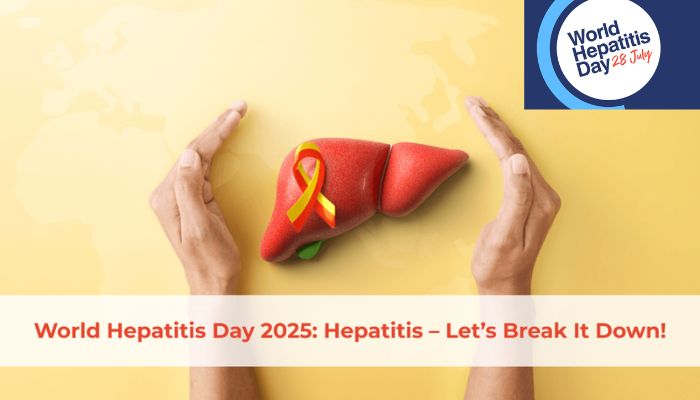
Health is the most precious gift of life, and yet we often take it for granted.
In modern medicine, many diseases are curable, but as the saying goes, “precaution is better than cure”; this is specifically true for the potentially life-threatening infection known as the “silent killer”, Hepatitis B.
Every July 28th, World Hepatitis Day is observed to raise awareness and promote efforts to increase vaccine accessibility worldwide.
Theme of World Hepatitis Day 2025
This year, the day is being observed with the theme, “Let’s Break It Down,” which calls for urgent action to dismantle the financial, social and systemic barriers, including stigma that stands in the way of hepatitis eradication and liver cancer prevention.
What is hepatitis, and how does it affect the human liver?
Hepatitis is an inflammation of the liver that is caused by a variety of infectious viruses and non-infectious agents.
Five hepatitis viruses known as:
Hepatitis A virus (HAV), Hepatitis B virus (HBV), Hepatitis C virus (HCV), Hepatitis D virus (HDV) and Hepatitis E virus (HEV) can infect human body.
Hepatitis B and hepatitis C (HBV and HCV) infection can become chronic and cause cirrhosis and liver cancer.
Is hepatitis a health threat of this decade?
Let’s Break It Down
A data compiled by the World Health Observatory (WHO) shows that viral hepatitis is a major public health challenge of this decade.
An estimated 1.3 million people died from chronic viral hepatitis B and C in 2022, with 3500 deaths per day.
Alarmingly, every day, 6000 people are infected with hepatitis.
Only 45% of babies received the hepatitis B vaccine within 24 hours of birth in 2022.
It’s pertinent to note that a timely dose at birth can prevent babies from developing liver cancer later in their lives.
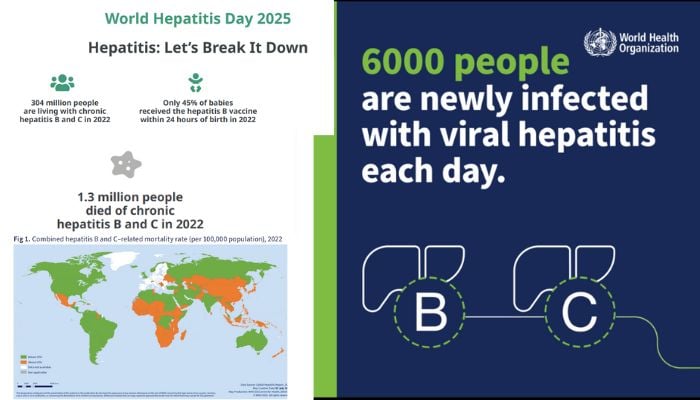
According to World Health Observatory data, there are 304 million living with hepatitis B and C, and alarmingly only 7 million are treated for hepatitis B and 12.5 million people for hepatitis C.
Mortality rate is increasing
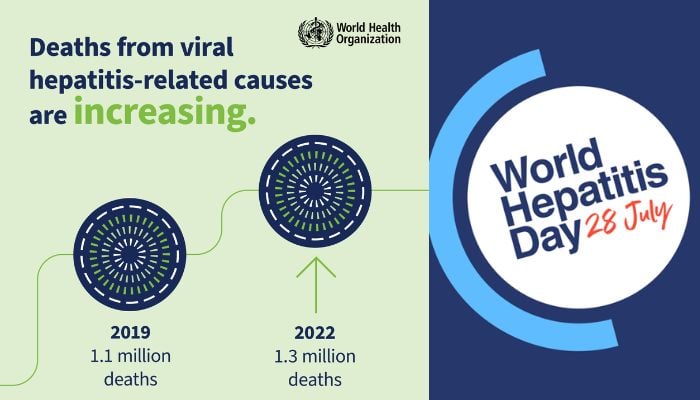
In 2019, 1.1 million deaths were reported and in just three years, the mortality rate has increased to 1.3 million.
Rapid diagnostic tests for hepatitis: Need of the hour
It’s only costs less than $2 for a rapid diagnostic tests. Yet there is limited use of these tests at primary health clinics due to funding shortages and lack of centralized testing in hospitals.
The generic tenofovir is manufactured locally in low-and middle-income countries in all geographic regions, yet less than 10% of people with chronic hepatitis B received it in 2022.
Do people really realize it?
Most people out of 304 million with chronic viral hepatitis don’t realize they have it. Therefore, testing is the first step towards timely treatment.
Can Hepatitis B and C cause Liver damage?
Chronic hepatitis B and C silently cause liver damage and cancer despite the fact that they are preventable, treatable and, in the case of hepatitis C, curable.
The theme for this year focuses on the need to simplify, scale up, and integrate hepatitis services-vaccination, safe injection practices, harm reduction and especially testing and treatment- into national health systems.
Act now to save lives from hepatitis
To sum-up, the campaign is a reminder that we must act now to expand access, integrate care, and end hepatitis as a public health problem by 2030.
High-impact interventions are available, such as an effective cure for hepatitis C and vaccines for hepatitis B, but access to these interventions must be urgently expanded to save lives and prevent a future generation from new infections, cancers and deaths.
So, it’s up to us to decide: do we want to see future generations infected by this "silent killer" or are we ready to act now to ensure vaccine accessibility for all?
Let’s break it down our priorities this World Hepatitis Day 2025!
Related: Family physicians breaking barriers






-
 Sony PlayStation State of Play reveals 'Castlevania' and 'Metal Gear' return
 -
 Kylie Kelce reveals why she barely planned her wedding day?
 -
 Paul Anthony Kelly opens up on 'nervousness' of playing JFK Jr.
 -
 'Finding Her Edge' creator explains likeness between show and Jane Austin novel
 -
 How AI boyfriends are winning hearts in China: Details might surprise you
 -
 James Van Der Beek's final days 'hard to watch' for loved ones
 -
 Will Smith, Jada Pinkett's marriage crumbling under harassment lawsuit: Deets
 -
 Khloe Kardashian reveals why she slapped ex Tristan Thompson