New study reveals clues to Australia's odd echidna origins
Echidnas evolved from water-dwelling mammals in a rare evolutionary shift, say researchers
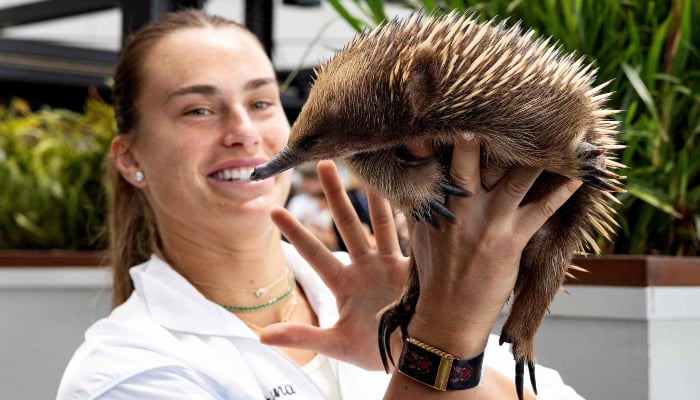
SYDNEY: Australia’s burrowing echidna evolved from an aquatic ancestor in what scientists have described as an "extremely rare" evolutionary transition, according to a new study released Tuesday.
Equipped with strong digging claws, spiny defences, and highly sensitive beaks, echidnas are perfectly adapted for life on land, shuffling through forest floors and undergrowth.
However, a team of Australian and international researchers now believe that many of these distinctive features first appeared millions of years ago, when the echidna’s ancestors lived a semi-aquatic existence."We're talking about a semiaquatic mammal that gave up the water for a terrestrial existence," said paleontologist Suzanne Hand, from the University of New South Wales.
"While that would be an extremely rare event, we think that's what happened with echidnas."
Echidnas and another Australian oddity, the semi-aquatic platypus, are believed to have evolved from a common ancestor called Kryoryctes cadburyi that lived in Australia more than 100 million years ago.
Researchers studied the single known bone fragment left by this ancestor, which was discovered among a trove of fossils at Dinosaur Cove in southern Australia some 30 years ago.
Platypus bones were similar to this ancient ancestor, Hand said, with a thick and heavy structure that provided ballast for diving.
Echidnas, in comparison, had very thin bone walls that made it easier to walk on land, Hand said.
This indicated echidnas were descended from a water-dwelling ancestor but had evolved to live on land, the research found.
It was far more common for prehistoric mammals to go from land to water, Hand said, pointing towards seals, whales, dolphins and dugongs.
The researchers said these findings appeared to be supported by other echidna traits.
Echidnas have backward-facing hind feet that help them shift mounds of soil when burrowing.
These feet may have first developed as rudders helping the echidna's ancestor navigate fast-moving waterways, Hand said.
Echidnas also have a "diving reflex" when submerged in water, which tells their body to conserve oxygen helping them hold their breath for longer.
Echidnas and platypus are monotremes, a rare group of mammals that lay eggs instead of live young.
"We're hoping we'll discover other ancestral monotremes that will help unravel the early history of this most fascinating group of mammals," said study co-author Michael Archer.
The research was published in peer-reviewed journal PNAS.


-
 Can we finally find aliens? Scientists reveal a surprising new ‘organizational’ approach
 -
 Study reveals how to tell real alien life from chemical fakes
 -
 Scientists find hidden third ancestral group in Japanese genomes
 -
 SpaceX ‘Space Junk’ is on a collision course with the Moon, scientists say
 -
 Do you know what happened on May 10, 1967? NASA's M2-F2 disaster explained
 -
 Why the Southern Ocean is melting: Antarctica’s sea ice resilience reaches a breaking point
 -
 Giant black holes are cosmic ‘Frankensteins’ built by mergers, new study reveals
 -
 NASA’s Artemis 2 moon launch becomes the largest event in Space Coast history
-
 Is success written in your DNA? New study reignites nature vs nurture debate
 -
Researchers found 240-million-year-old giant mysterious 'sand creeper'
-
New solar-powered process turns plastic waste into clean hydrogen
-
Giant squid detected off Western Australia coast as deep-sea study reveals hidden species
-
Astronomers discover unexpected atmosphere beyond Pluto on tiny solar system object
-
‘Evolution is not always random’: Study finds same gene reused for 120 million years
-
Real-life Tatooine moment: Astronomers discover 27 ‘Star Wars’ like planets orbiting two suns
-
SpaceX launches 45 satellites on Falcon 9 Rideshare from Vandenberg
-
NASA Artemis II crew shares Moon secrets on The Tonight Show Starring Jimmy Fallon
-
SpaceX launch today: How to watch CAS500-2 live