
Nasa JWST discovers one of earliest 'truly gargantuan' supernovas
Supernova erupted around 11.4 billion years ago in massive early galaxy
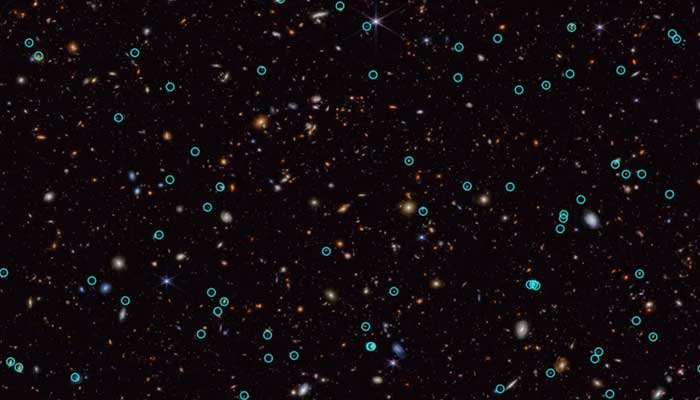
One of the most distant and, thus, earliest star-killing supernovas ever seen has been discovered by astronomers with the help of the James Webb Space Telescope (JWST).
After the Big Bang, around 2 billion years, this blast which rocked the cosmos marked the death of just such a monster star, reported Space.com.
This supernova, which was detected as part of the JWST Advanced Deep Extragalactic Survey (JADES) programme, could help scientists add more detail to the cosmic picture of stellar life and death they are currently building.
Designated AT 2023adsv, the supernova erupted around 11.4 billion years ago in a massive early galaxy.
Excitingly, in the local universe, this stellar explosion may be somewhat different from the supernovas that have occurred more recently. The high-energy blast, in particular, seems to have been excessively violent.
"The first stars were considerably different than the stars today. They were massive, they were hot, and they had truly gargantuan explosions," JADES team member and Space Telescope Science Institute (STScI) researcher David Coulter said at the 245th meeting of the American Astronomical Society (AAS) in National Harbour, Maryland, on Monday (January 13).
He added: "We don't know how many [supernovas] the JWST will find but we can start to push to the beginning of these first stars and hope to see their explosions."



-
 Arizona’s Meteor Crater continues to reveal new discoveries 50,000 years later: Here’s why
 -
 Can you see Earth’s shadow? Answer may surprise you
 -
 Hidden topological universe found in entangled light
 -
 Brazil fossil of giant dinosaur reveals continents were connected 120 million years ago
 -
 NASA prepares Artemis astronauts crew for first Moon mission in decades
 -
 Comet 3I/ATLAS puzzles scientists, revealing secrets of alien worlds
 -
 Scientists unlock whale longevity secrets – Could humans live 200 years?
 -
 Were humans born on Mars? Scientists raise a stunning possibility