Taxi driver in El Salvador gets rich through Bitcoins
Napoleon Osorio now has Bit-Driver brand; he no longer struggles to pay for his children's educations
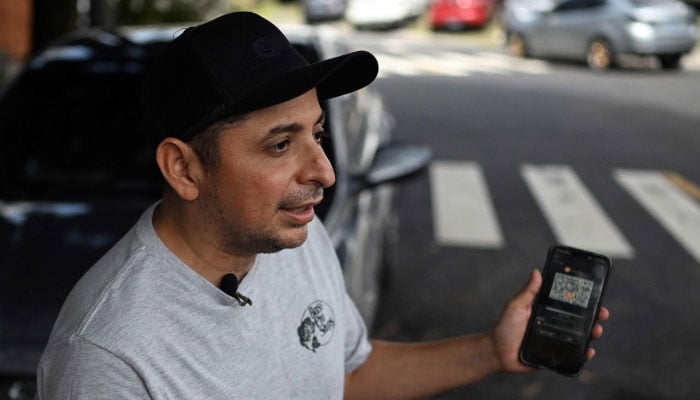
SAN SALVADOR: Napoleon Osorio is the first taxi driver to accept payment in Bitcoins in the first country of the world, El Salvador, that has made cryptocurrency legal.
He credits President Nayib Bukele's decision to bank on Bitcoin three years ago with changing his life.
"Before I was unemployed [...] and now I have my own business," said the 39-year-old businessman, who uses an app to charge for rides in Bitcoin and now runs his own car rental company.
Three years ago the leader of the Central American nation took a huge gamble when he put Bitcoin into legal circulation in a bid to revitalise El Salvador's dollarised, remittance-reliant economy.
He invested hundreds of millions of dollars of taxpayer money in the cryptocurrency, despite warnings about volatility risks from global institutions.
Osorio credited the US founder of the NGO "My First Bitcoin", John Dennehy, with encouraging him to accept payment in the cryptocurrency.
He now has 21 drivers working for his Bit-Driver brand and has made enough profit from the currency's rise to be able to buy four rental vehicles.
A divorced father of two teenagers, he also no longer struggles to pay for their education.
Offered as option
While Osorio has grown relatively wealthy with Bitcoin, a study by the University Institute for Public Opinion showed that 88% of Salvadorans had yet to use it.
"From the beginning [...] it was clear that it was clearly an ill-advised measure that the population rejected," the director of the institute, Laura Andrade, told AFP.
One-quarter of Salvadoran GDP comes from remittances sent home by family members, mostly from the United States.
But in 2023 only 1% of the transfers were made in cryptocurrencies.
In an interview with Time magazine in August, Bukele acknowledged that while "you can go to a McDonald's, a supermarket, or a hotel and pay with Bitcoin" it had "not had the widespread adoption we hoped for."
He added that "the positive aspect is that it is voluntary; we have never forced anyone to adopt it. We offered it as an option, and those who chose to use it have benefited from the rise in Bitcoin."
He also confirmed that he had around $400 million in Bitcoin that is kept in a public "cold storage wallet" — a way of storing Bitcoin offline.


-
 Google and Unity partner on new AI game creation platform
 -
 Sources reveal truth behind French brand Lacoste CEO getting fired ahead of Paris runway show
 -
 Canadian rents hit three-year September low after 24 months of declines
 -
 Google under fire in £1 billion UK case over app store charges
 -
 Anthropic CEO Dario Amodei pulled in $18 Million last Year, IPO filing shows
 -
 X faces pressure to reject Turkey’s broad requests to block accounts
 -
 Euro plunges to 17-month low as France debt and Spain election fuel uncertainty
 -
 OPEC+ agrees to keep November oil targets steady amid market uncertainty