
Mars have 'spiders': Will you still live there?
Spider like creatures are shown in new image of Mars
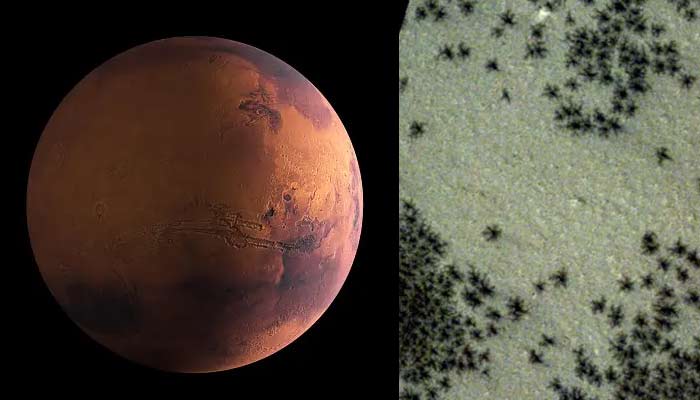
Arachnophobes don't have to worry, as in reality, a recent photograph of Martian "spiders" from the European Space Agency (ESA) depicts the Red Planet's yearly carbon dioxide gas eruptions.
The dark, spindly formations were observed in the southern polar zone of Mars, in a place known as Inca City. It revealed black clumps of dots that resemble tiny spiderlings curled up together, according to Live Science.
Gas channels that range in width from 0.03 to 0.6 miles (45 metres to 1 kilometre) make up the formations.
They begin as the southern hemisphere's weather warms during Martian spring, melting layers of ice that contain carbon dioxide. Moreover, the lowest layers of ice sublimate, or convert into gas, as a result of the warmth.
Dark dust from the solid top is carried by the gas as it rises and expands, exploding out of the layers of ice above it. This dust forms the fractured, spiderweb-like pattern here by erupting from the ice and then raining down onto the upper layer.
According to ESA, the geysers have been known to erupt through ice up to 3.3 feet (1 m) thick in some locations.
Another name for Inca City is Angustus Labyrinthus. It got its name from the linear, ruin-like ridgelines that resembled old Martian glaciers that may have left behind high walls of sediment as they receded.
Originally, it was believed that these ridgelines were petrified dunes.



-
 Arizona’s Meteor Crater continues to reveal new discoveries 50,000 years later: Here’s why
 -
 Can you see Earth’s shadow? Answer may surprise you
 -
 Hidden topological universe found in entangled light
 -
 Brazil fossil of giant dinosaur reveals continents were connected 120 million years ago
 -
 NASA prepares Artemis astronauts crew for first Moon mission in decades
 -
 Comet 3I/ATLAS puzzles scientists, revealing secrets of alien worlds
 -
 Scientists unlock whale longevity secrets – Could humans live 200 years?
 -
 Were humans born on Mars? Scientists raise a stunning possibility