Green 'Devil Comet' likely to block total solar eclipse as it approaches near Earth
Green "Devil Comet" can be seen by naked eyes as it passes through Earth in April
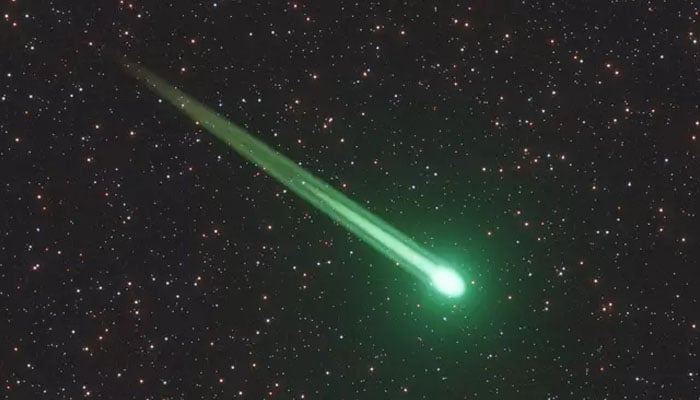
The exploding "devil comet" may show its hornless, greenish-tinged head on April 8 during the total solar eclipse.
Photographs of the unusual cosmic event may feature the city-sized comet, which is presently speeding toward Earth. Furthermore, according to one researcher, the comet might be visible to the naked eye if it breaks out before totality, which is the part of the eclipse when the Sun is totally obscured.
The comet commonly referred to as the devil comet, 12P/Pons-Brooks (12P), has a width of 10.5 miles (17 kilometres) and orbits the sun in a highly elliptical pattern approximately every 71 years.
Comet 12P is an ice volcano or cryovolcanic comet. This indicates that it periodically erupts when solar radiation causes a fissure in its icy shell, or nucleus, enabling it to blast cryomagma—a mixture of gas and ice—out of its icy interior and into space.
The comet's coma, or the cloud of gas and dust surrounding its core, increases as a result of the cryo magma, giving the comet a noticeably brighter appearance for the next several days.
For the first time in 69 years, 12P blew its top in July of last year, and it has erupted quite regularly ever since. Asymmetry developed in the comet's extended coma during 12P's early eruptions.
Because of this, it appeared to have horns, earning it the moniker "demonic." These horns have not been present during more recent eruptions, though.
High concentrations of dicarbon in the comet's coma and tail are the reason behind its green light, which is visible in recent images of the object.
When seeing a partial eclipse, you should always wear protective eyewear, such as licensed eclipse glasses. It is safest to look directly at the Sun at totality when the moon fully blocks out the sun. If you don't, you risk irreversible eye damage.


-
 Blue Origin upgrades new Glenn rocket launch infrastructure to take on SpaceX
 -
 NASA’s next Mars mission targets Phobos and Deimos, not Red Planet
 -
 Is AI ready to rewrite our understanding of physics?
 -
 Astronomers identify possible first green star in 27 years of research
 -
 New study sounds alarm as Doomsday Glacier melts more aggressively than thought
 -
 Hubble data hints at planet born after its star died
 -
 NASA to brief public on Artemis III mission progress
 -
 ‘Time capsule beneath the sea’: World’s oldest shipwreck holds secrets from Great Pyramid era