Gaza families wear bracelets to identify loved ones, avoid mass burials
Gaza's health ministry says 756 Palestinians, including 344 children, have died in last 24 hours
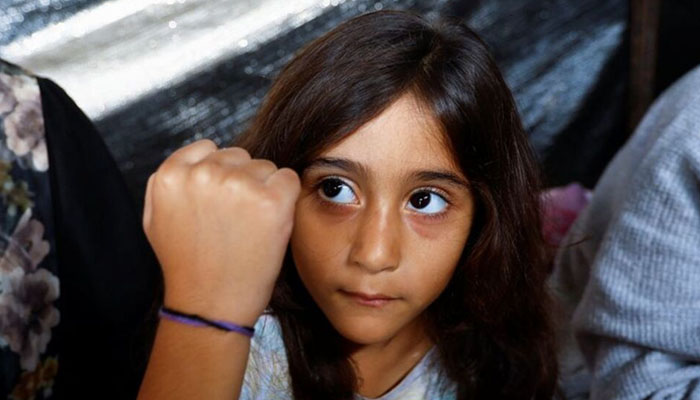
In an effort to identify their loved ones in the event of a fatal accident, some Gaza families are now employing bracelets as Palestinians were burying the unidentified dead in mass graves with a number instead of a name.
The El-Daba family has made an effort to lessen their chance of being hit during the most intense Israeli attack on Gaza to date.
Gaza's health ministry announced on Wednesday that 756 Palestinians, including 344 children, had died in the previous twenty-four hours.
According to the report, since October 7, at least 6,546 Palestinians—including 2,704 children—have died as a result of Israeli airstrikes.
After 1,400 people were killed and hostages were captured on October 7, when Hamas militants attacked Israeli communities, Israel began the airstrikes.
The bombing, according to 40-year-old Ali El-Daba, tore apart victims that were unrecognisable.
He claimed that he divided his family so that no one member would die in a single attack. He claimed that his 42-year-old wife Lina maintained custody of two of their kids and two daughters in Gaza City, while he and the other three children relocated to Khan Younis in the south.
El-Daba said he was preparing for the worst. He bought blue string bracelets for his family members and tied them around both wrists. "If something happens," he said, "this way I will recognise them."
There were also other Palestinian families who were putting their children's names on their arms or purchasing or crafting bracelets for their kids.
Mass burials
Muslim leaders in the area have approved mass burials. Prior to burial, medical professionals number the deceased and save their photos and blood samples.
The Israeli military has ordered residents to move south of the Gaza Strip, which is safer, and away from the north, which is among the world's most populated areas. However, airstrikes have reached the Hamas-controlled area.
An Israeli military spokesperson said, "The IDF (Israel Defense Forces) has been encouraging residents of the northern Gaza Strip to move southward and not to stay in the vicinity of Hamas terror targets within Gaza City."
"But, ultimately, Hamas has entrenched itself among the civilian population throughout the Gaza Strip. So wherever a Hamas target arises, the IDF will strike at it in order to thwart the terrorist capabilities of the group, while taking feasible precautions to mitigate the harm to uninvolved civilians."
After one of the worst days for Palestinians since October 7, Israel's military increased its bombing of southern Gaza overnight. Leaders from around the world have demanded that the combat stop so that supplies of food, gasoline, water, and medications can reach the besieged area.


-
 UK pushes EU to include British firms in 'Made in Europe' industrial scheme
 -
 Bill aimed at protecting Americans from data centre energy costs blocked in Senate
 -
 ICE officer, accused of shooting Venezuelan man and lying to investigators, pleads not guilty
 -
 Trump officials move migrants children to unlicensed Texas facilities, raising deportation fears
 -
 New UFO files reveal chilling details of 1952 ‘flying saucer’ incident
 -
 How a ‘millisecond’ software glitch caused six hours of chaos across UK airports
 -
 Russia takes over Nestlé and Auchan operations amid growing nationalisation campaign
 -
 Zelenskyy launches ‘Carpathian Eight’ initiative as Russia-Ukraine conflict escalates