Mongolia's Kazakh-origin eagle huntresses no longer caught in patriarchy's talons
Mongolia has a long history of Kazakh-origin women hunting eagles
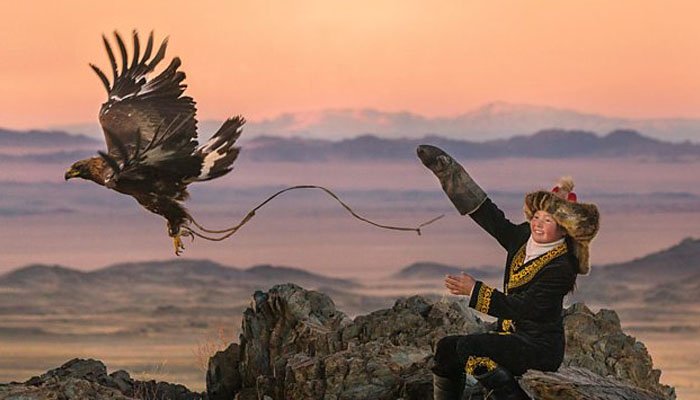
A group of girls and women in Mongolia, mainly of Kazakh origin are challenging current patriarchal norms and gender roles by keeping their old tradition of eagle hunting alive.
"Eagle hunting always included women," said Adrienne Mayor, a Stanford University historian describing the history of the activity as covered in a 2016 research paper titled The Eagle Huntress - Ancient Traditions and New Generations.
Additionally, archaeology reveals that eagle huntresses were more prevalent in earlier periods.
Only the Kazakhs of western Mongolia's Altai mountain area hunt with golden eagles, and there are currently 400 active falconers among them.
When teenage eagle huntress Aisholpan Nurgaiv was the subject of a widely shared photograph made by Israeli photographer Asher Svidensky in 2013, Kazakh women in Mongolia attracted attention from all around the world.
In 2014, he visited the nation once more along with British filmmaker Otto Bell, who had produced a documentary about the adolescent.
The storyline focused on her being an outlier in Kazakh culture in what Bell described as an “isolated” community with “a certain kind of ignorance about what woman can do”.
These remarks were made during a press interview on CBS's Mountain Morning Show in January 2016, where he also said she was the “first woman to eagle hunt in the 2,000-year-old male-dominated history”.
But Kazakhs and historians say this is not true, as many women have hunted throughout Mongolia's history.
The eagles are not bred in captivity; rather, they are captured as young birds from nests. Female eaglets are preferred since they develop into larger adults. A huge adult female can weigh up to seven kilograms and have a wingspan of more than 230cm.
A hunter releases his grown eagle for the last time on a spring morning after years of service, leaving a butchered sheep on the mountain as a farewell gift. For the benefit of future generations, Svidensky explains that this is how the Kazakh eagle hunters ensure that the eagles return to nature and have their own powerful infants.


-
 Yankees extend Brian Cashman's tenure after another disappointing playoff exit
 -
 Poland's abortion ban faces new challenge as lawmakers vote to loosen restrictions
 -
 New York Democrat Brad Lander released after detention in West Bank
 -
 Ohio chemical tank explosion triggers mass evacuations and shelter-in-place orders in Toledo
 -
 Trump suffers record low approval rating weeks before US midterm elections
 -
 El-Sayed leads Rogers by a narrow margin as Michigan Senate election approaches
 -
 Russia ready for new Ukraine peace talks in November after Putin-Witkoff meeting
 -
 Macron warns Trump, other foreign leaders to stop using France riots for political gain
-
 Cost of living crisis deepens as fuel price surge pushes UK inflation to 10-month high of 3.5%
 -
Ukraine’s Zelenskyy backs ceasefire, calls for fresh talks with US and Russia
-
Pope Leo XIV rides popemobile for first time since lung cancer surgery
-
Russia frees 74-year-old US citizen Stephen Hubbard as Putin-Witkoff meeting continues