
Experts shed light on what new PTI move would mean for economy
"Political instability might scare off investors, weaken rupee further and drive up inflation," says researcher
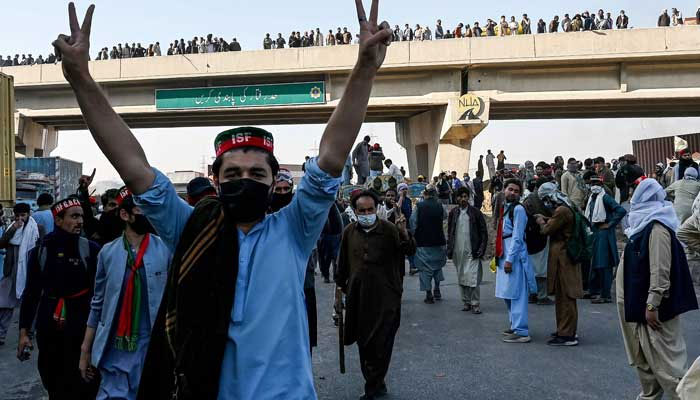
KARACHI: The Pakistan Tehreek-e-Insaf’s (PTI) plans to initiate a civil disobedience movement, encouraging overseas Pakistanis to limit their remittances, could hurt the economy, say experts.
Former Prime Minister Imran Khan, who has been imprisoned since August 2023 on multiple charges, has threatened to launch a nationwide civil disobedience campaign from December 14 if party demands are not met. As part of this movement, overseas Pakistanis will be encouraged to reduce their remittances and participate in a boycott campaign.
“If the PTI launches a civil disobedience movement, it could have serious consequences for Pakistan’s economy. Remittances, which bring in over $30 billion annually, might drop if people are encouraged to use informal channels like hawala instead of official banking systems,” said Saad Hanif, head of research at Ismail Iqbal Securities. “Political instability might scare off investors, weaken the rupee further, and drive up inflation, making life harder for ordinary people. Overall, it could disrupt the government’s plans and push the economy deeper into crisis,” he added.
Awais Ashraf, director research at AKD Securities Limited, does not believe that potential civil disobedience will significantly impact remittance flows, as people send this money to support their families and some flows are earnings of freelancers.
Remittances to Pakistan have increased to $11.8 billion in July-October FY25, up 34.7 per cent from the same period last year, providing crucial support to the external account.
Both the government and the central bank anticipate that remittances will reach historic levels of $35 billion in FY25, averaging $2.9 billion per month so far. These significant inflows will strengthen the reserves, offering a much-needed boost to the economy.
A senior banker said that we need to observe how Pakistani expatriates respond to the planned call.
In reality, Pakistan regularly receives significant remittance inflows from its migrants working abroad, most of whom belong to the lower and middle classes and typically engage in blue-collar jobs in Gulf countries, particularly Saudi Arabia and the United Arab Emirates, he said.
However, the expatriates who may have acquired nationality in their host countries often send funds back home during occasions such as Eid festivals, for Hajj, for charity, and for making investments in Pakistan.
Khan’s latest announcement comes at a time when the nation’s struggling economy is on the mend, largely thanks to a bailout from the International Monetary Fund. As a result, inflation has decreased, dropping to 4.9 per cent in November.
The current account balance shifted to a surplus of $218 million in the first four months of the fiscal year 2025, compared to a deficit of $1.528 billion in the same period last year. As of November, the foreign exchange reserves held by the State Bank of Pakistan amounted to $12 billion, which is sufficient to cover more than two months of imports. Interest rates have also fallen, decreasing by 700 basis points to 15 per cent since June. Moreover, Pakistan’s benchmark stock index has performed well, surpassing 100,000 points.
If the economy suffers as a result of the political unrest, the IT industry, which is already suffering from slow speed, is likely to experience more difficulties.
The consistent internet disruptions and its slow speed are detrimental to the national economy in general and IT sector in particular, which will further affect adversely the economic activities and damage the reputation of the country if the situation persists, said Saad Shah, an IT exporter.
As far as the IT sector is concerned, various IT companies are facing challenges to complete their projects on time despite their multiple efforts of working extra hours due to the prevailing internet situation. Large IT companies having annual contracts with local and foreign clients may survive through managing their work from offshore offices, but medium and small players including freelancers could not have options but to lose projects and clients, Shah added
Hanif also expressed that “[civil disobedience] would reduce the country’s foreign exchange reserves. The government could also struggle to collect taxes and utility bills, worsening its financial problems and delaying important projects,” Hanif said.
In a message posted on X, Khan announced the formation of a five-member negotiation team.
This team is tasked with discussing two key demands with the government: the release of under-trial prisoners and the establishment of a judicial commission to investigate the incidents that occurred on May 9, 2023 and November 26, 2024 -- dates that saw significant protests from Khan’s supporters, which were met with a crackdown from the government and security forces.







-
 Why Prince Philip Could Not Be In Same Room As Sarah Ferguson
 -
 US-Iran Agreed On Principal Deal To Open Strait Of Hormuz In Landmark Negotiations
 -
 Lisa Ann Walter Shares Excitement About Her New Comedy Show 'It Was An Accident'
 -
 Princess Beatrice, Princess Eugenie Grateful For Royal Inclusion Despite Woes
 -
 Phil Collins Gives Hopeful Update After Years Of Serious Health Problems
 -
 Nobel Peace Laureate Maria Corina Machado To Return Venezuela For 2026 Presidential Run
 -
 Meghan Markle And Princess Catherine Divide Reignited After New Family Images
 -
 Manchester United: Bruno Fernandes Breaks All-time Assist Record In Premier League
 -
 Force Strikes Back As 'The Mandalorian And Grogu' Hauls Jaw-dropping Box Office Figure
 -
 Katie Price Posts Late-night Messages While Lee Andrews Remains Unaccounted For
 -
 Nancy Guthrie Update: Spotlight On Savannah Guthrie's Mom Past Newsroom Life
 -
 China Launches Three-crew Spaceflight As Part Of 'Shenzhou-23 Mission'
 -
 Kim Kardashian Once Warned Drake On Social Media Over Family 'threats'
 -
 AI Version Of Iconic ‘Moonrise’ Photo Sparks Rights Backlash
 -
 Sebastian Stan Drops Three-word Reaction For Terrifying Two-Face Look In 'The Batman Part II'
 -
 Nvidia AI Chief Reveals How To Get Past Automated Hiring Systems