
Military spokesman leaves big question mark over Imran’s fate
DG ISPR avoided giving direct answer to whether Imran Khan’s custody would be handed over to military
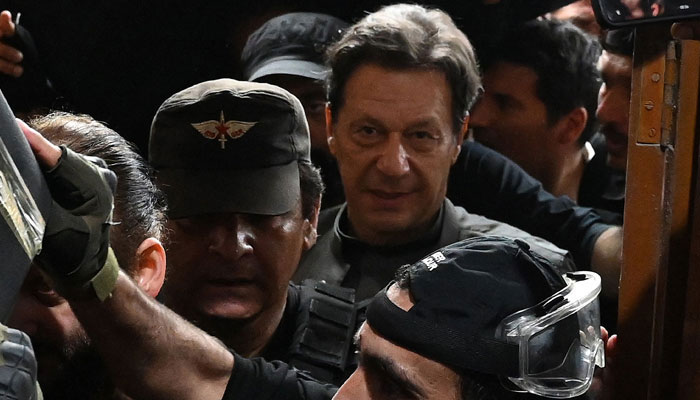
ISLAMABAD: The question whether Imran Khan will be tried in a military court in connection with Lt Gen (R) Faiz Hameed case remains unanswered; however, it is clear that there are no concerns for former Army Chief Gen (R) Qamar Javed Bajwa. During his press conference on Thursday, the DG ISPR avoided giving a direct answer to the question whether Imran Khan’s custody would be handed over to the military authorities for his trial under the Army Act. He neither confirmed nor denied the possibility. The question was asked in the context of Lt Gen (R) Faiz Hameed’s arrest and court martial proceeding, with the PTI leaders fearing that Imran Khan’s custody could be transferred to military authorities, potentially leading to his trial in a military court under the Army Act.
In his response, the DG ISPR stated that the question asked is hypothetical and related to a matter that was sub judice. However, he also highlighted that under military law, if any individual uses anyone subject to the Army Act for personal or political gains, and there is evidence to support this, the law will take its own course.
It implies if the military authorities find evidence that Imran Khan used Lt Gen (R) Faiz Hameed for his (Imran Khan) personal or political gains, then his custody could indeed be transferred to the military authorities for trial under the Army Act. The DG ISPR, however, did not comment directly on any connection between Imran Khan and Lt Gen (R) Faiz Hameed.
The DG ISPR was also asked the military’s view on the roles of former army chief General (R) Qamar Javed Bajwa and ex-DG ISI Lt Gen (R) Naveed Mukhtar in promoting and appointing Lt Gen (R) Faiz as DG ISI. In response, the military spokesman posed a counter question, “Who is the direct boss of ISI? Why didn’t you talk about the then prime minister?” Emphasizing the military’s strict and transparent accountability system, he asserted that it does not operate on the basis of mere allegations. The ISPR chief reiterated that the military accountability system is based on solid evidence.
Referring to the ISPR’s earlier press release on Lt Gen (R) Faiz’s arrest, the DG ISPR said that the officer (Lt Gen (R) Faiz) had overstepped his constitutional and lawful bounds for personal interests and at the behest of particular political elements. He added that it would be unfair to link others, without any evidence, to the violations committed by the officer who had gone beyond his constitutional and legal limits for his own vested interest. The DG ISPR’s answer to the question relating to Gen (R) Bajwa and Gen (R) Mukhtar strongly suggests that there is no evidence implicating the two retired generals in the case involving Lt Gen (R) Faiz.







-
 Palace Shares Rare Update On King Charles’ State Visit To See Donald Trump
 -
 Garth Brooks's Comeback Fear Exposes Deeper Dependence After Rape Accusations
 -
 SpaceX Kicks Off IPO Process, Eyes Record $75 Billion Offering
 -
 Where Dak Prescott And Sarah Jane Ramos Stand About Their Relationship As Canceled Wedding Nears
 -
 Sarah Ferguson To Come On ‘Traitors’ Or ‘Big Brother’? Plans Come To Light
 -
 Misua, 'Drag Race: Philippines,' Breathes Her Last At 27
 -
 US Targets China Chip Sector With New Export Curbs On ASML
 -
 Kelly Ripa Makes Bombshell Confession About Pregnancy After 23 Years
 -
 King Charles True Feelings Show 'thawing' Relations With Eugenie And Beatrice Amid Andrew Scandal
 -
 Trump Administration Labeled ‘misogynistic’ Following Dismissal Of Pam Bondi And Kristi Noem
 -
 Trump Mocks Starmer As UK–US Tensions Rise Over Defence
 -
 'Peaky Blinders' Has Major Casting Shakeup For Lead Role In Upcoming Sequel Series
 -
 Quantum Computing Threat: Why Global Cybersecurity Could Collapse Soon
 -
 Jessica Simpson Reveals Rare Approach To Mastering 'Daisy Duke's Glow
 -
 Princess Beatrice’s Real Feelings About Andrew, Fergie: ‘They Ruined Nearly Every Aspect Of Her Life & Marriage’
 -
 AI Cyberattacks Set To Outpace Human Hackers, Experts Warn