
Economic disconnect
Seldom before has Pakistan become locked in such a widespread economic slowdown coinciding with uncertain politics
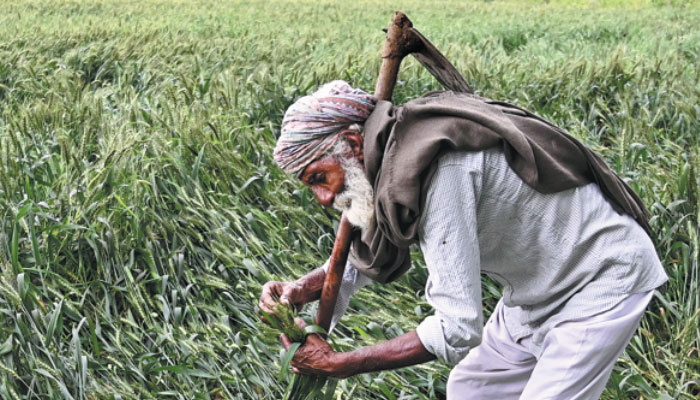
As Pakistan’s farmers grapple with the terrible fallout from this year’s crash of domestic wheat prices, the Punjab government’s plan to set up a glass-roof train commuting from Islamabad to Murree smacks of nothing short of an economic disconnect.
It is yet another example of a failure to address the biggest challenges faced by Pakistan’s mainstream population, saddled with dangerous stress led by worsening food insecurity and a failure to make ends meet.
The disconnect vividly illustrated with the planned glass-roof train while real-life challenges are ignored comes as Pakistan began another troublesome financial year this week. It is increasingly becoming clear that tackling the worst economic crisis in the nation’s history may well be beyond the capacity of Prime Minister Shehbaz Sharif’s government.
Seldom before has Pakistan become locked in such a widespread economic slowdown coinciding with uncertain politics. Meanwhile, the outlook for the future has not been helped by a budget that seems to have failed to lock in many more areas for tax collection.
Though projections for tax collections for the July 2024-June 2025 financial year will see higher rates for indirect taxes, a major gap remains in expanding the sources of direct tax collections much more robustly. While higher rates for taxes have been slapped upon Pakistan’s high-income earners, the tragic reality is fundamentally just one: the people who pay income tax are far too few to be counted.
The failure to reform Pakistan’s widely dysfunctional tax collection stands at the heart of the country’s recurring economic failures.
On a closely related note, Pakistan’s repeated reliance on borrowings from the country’s local banks to meet the government’s recurring fiscal deficit has undermined the country’s economy in more ways than one. Such borrowings have practically crowded out the private sector from gaining access to bank loans – already an uphill struggle for borrowers given the central bank’s lending rate at over 20 per cent.
Going forward, Pakistan’s economy will just not be revitalized unless its future is built upon reforms in at least three interlinked areas.
First, the burden of the collection of direct taxes needs to be far more equitably distributed without any sector remaining exempt from being counted. For years, critics have pointed towards Pakistan’s politically powerful landowners for presiding over large tracts of farmland that remain exempt from paying an income tax.
Yet, the widespread evasion across the board includes owners of businesses and industries which pose an equally profound challenge to Pakistan’s financial autonomy and future progress. Together, the class of tax evaders represents a regressive category of Pakistan’s economic barons who pose the biggest challenge to the country’s future.
Second, the failure of successive governments to reform Pakistan’s tax collections has ultimately forced one regime after another to borrow excessively from international sources and domestic banks. It is therefore hardly surprising that there are far too few opportunities for entrepreneurs in Pakistan to rely on domestic bank loans, even if they can afford to meet the costs of those loans given on high-income rates. Going forward, a revival of Pakistan’s fortunes lies in rejuvenating its investment opportunities across the board.
Finally, Pakistan’s future prosperity needs far more serious long-term planning than being led by fanciful ideas. Initiatives such as high-speed road links or glass-covered trains will simply fail to revitalize Pakistan as a robust economic power. The danger is indeed that of the country’s dangerous debt burden posing more serious stress under the weight of added debt, with no indication in close sight of that stress beginning to ease out.
As a case in point, this year’s crashing prices of domestic wheat deserve to be well understood as a blunder that ought never to be repeated. That Pakistan chose to import a large quantity of wheat for domestic consumption was simply a colossal blunder. It appears now that the math was just not done for a cost-benefit analysis that closely assessed the expected domestic output. To make matters worse, Pakistan’s provincial governments stepped ahead and offered to purchase each maund (40 kgs) of wheat for approximately four thousand rupees. Today, the price of each maund of wheat has fallen to below three thousand rupees. The crash came after Pakistan’s provincial governments did not step up to purchase their promised stocks.
Going forward, the disconnect between Pakistan’s ruling structure and the mainstream population is set to just further deepen. In a country where the trust between the rulers and the ruled is already running thin, the economic direction is set to deepen the popular malaise.
As Pakistan prepares for another wet spell in the coming days driven by monsoon rainfall, mechanisms for climate resilience must take priority. Instead, saddling Pakistan with more debt in the name of projects such as a glass train will simply fail to stem what is already a fast-deepening rot.
The writer is an Islamabad-based journalist who writes on political and economic affairs. He can be reached at: farhanbokhari@gmail.com


