Present status: Pakistan has about 52 million children of school going age, of whom about 23 million are not attending school at all. Pakistan has the second highest number of out-of-school children in the world. The key reason being that successive governments have failed to allocate sufficient resources to education, and the poor parents lack the resources to send their children to private schools.
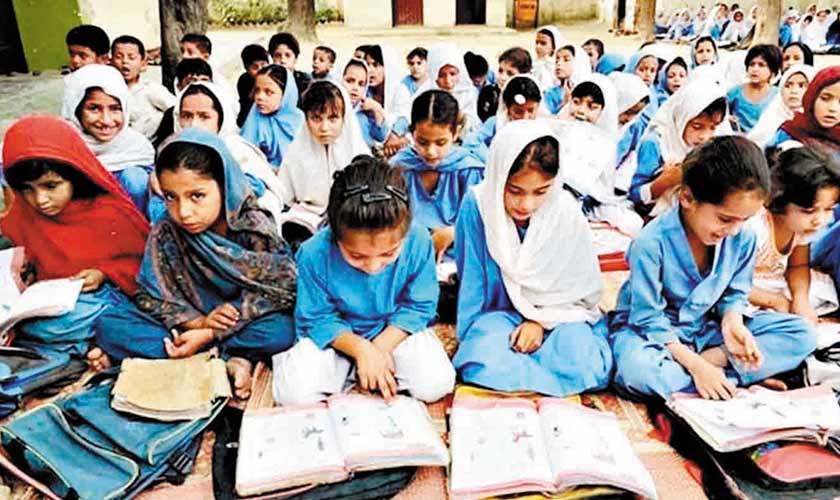
Present status: Pakistan has about 52 million children of school going age, of whom about 23 million are not attending school at all. Pakistan has the second highest number of out-of-school children in the world. The key reason being that successive governments have failed to allocate sufficient resources to education, and the poor parents lack the resources to send their children to private schools.
About 18 million children are going to government schools, where independent studies have shown that even a fifth-grade student, on average, cannot write a sentence in Urdu. About 52 percent of government schools in the country lack electricity, boundary walls, clean drinking water, furniture, and toilets. The teachers are mostly incompetent as they are not hired on merit. Pakistan is ranked 172nd in the world on school enrolment, and on how much the government spends on education.
Bangladesh has improved access to primary school education at twice the rate of Pakistan, while India is reducing the number of out-of-school children at ten times the rate as compared with Pakistan.
We are falling behind in education to not only South Asia but even Africa. Only about 11 million out of 52 million children who are studying in private schools are getting a decent level of education. Even poor parents prefer to send their children to low-cost private schools rather than the “free” government schools, understanding the quality difference.
A way forward: The dismal status of education is not only due to insufficient resources provided by the government on education, but also poor governance and management of the schooling system. The present centralised and bureaucratic schooling system lacks accountability, whereby the political leadership and bureaucracy is not held accountable for poor outcomes, for failing to improve net enrolment, and for providing a reasonable quality of education.
One schooling system that has been proven to be very effective in Pakistan, and in many other countries, is based on government funding – private delivery. Under this system the government provides monthly education vouchers, and the poor parents have the right to choose a low-cost private school from the list approved by the government. If poor parents are not satisfied with the quality of education of the low-cost private school, they can move their child to another low-cost private school, and the government funding also moves accordingly.
This competition among low-cost private schools to attract students ensures much better quality of education than in government schools. Presently, about two million children are studying under this system under Punjab Education Foundation (PEF), and around half-a-million under Sindh Education Foundation (SEF). The World Bank has recognised PEF as the most cost-effective schooling programme globally.
Under this system the government does not have to build thousands of schools, and can use that money to enrol more children by providing them with education vouchers. The average cost of educating a child for the government under this system is about Rs1,000 per month, which is substantially lower than what the provincial governments are spending on educating children in government schools.
Raising funds: In 2004, the Indian government introduced education cess at two percent of tax liability (including income tax, customs, service tax and excise duties) in order to meet government’s commitment to provide and finance universalised quality basic education needs of poor people of India.
In 2007, the Indian government raised the cess by an additional one percent to also fund secondary and higher education. Overall, three percent education cess was charged on all types of taxes. In 2018, the cess was increased to cover basic health care as well.
During the 2004-2019 period the Indian government raised INR 4,258 billion in education cess. The increased education funding has enabled India to increase the number of schools by around 33 thousand, and hire an additional 1.5 million teachers in the 2015 to 2019 period.
The literacy rate has also gone up to 74 percent in 2018 from 62 percent in 2006. The enrolment ratio for primary education in India is around 90 percent versus 67 percent in Pakistan. The total education spending in India is around 3.8 percent of GDP versus about 2.8 percent of GDP in Pakistan.
Introduce education cess in Pakistan: As mentioned above, Pakistan is ranked at the bottom in the world on school enrolment, and how much the government spends on education. It is proposed that an education cess be introduced in Pakistan in the upcoming 2021-22 budget to deal with the most important issue facing the country.
As per 2020-21 budget federal sales tax and federal excise duty are estimated at Rs2,280 billion, and provincial sales tax at Rs290 billion. An education cess can be introduced at 0.1 percent and 0.25 percent over and above the prevailing federal and provincial sales tax respectively ie, the federal sales tax will be increased to 17.1 percent and similarly provincial sales tax rates will be increased by 0.25 percent.
This will generate education cess of around Rs18 billion. This amount should be used to provide education vouchers to parents of poor children to enrol in low-cost private schools from grade 1 till 10. At an average cost of Rs1,000 per child per month, 1.5 million additional children can be enrolled in schools in the next fiscal year. Funding can be provided through Provincial Education Foundations or reputable non-profit education organisations to be utilised based on the public funding – private delivery model explained above.
The writer is CEO of NBP Funds