SpaceX sends up 60 mini-satellites with plans for thousands more
SpaceX sends up 60 mini-satellites: A Falcon-9 rocket launched from Cape Canaveral, Florida, placed 60 mini-satellites in orbit, joining 60 others launched in May.
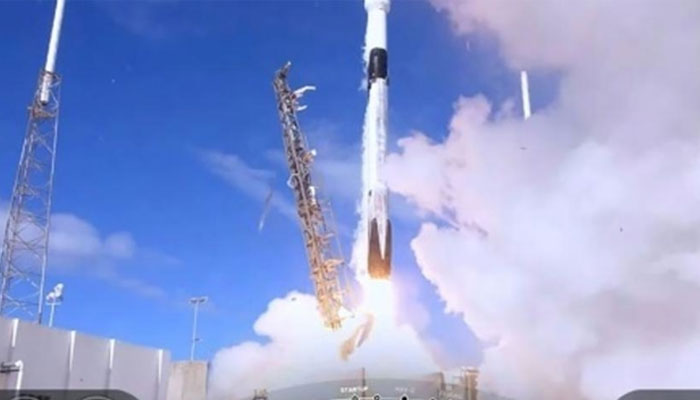
WASHINGTON: The private SpaceX company on Monday launched a second set of mini-satellites as it builds a huge constellation of the small orbiting devices aimed at greatly expanding internet access around the globe.
A Falcon-9 rocket launched from Cape Canaveral, Florida, placed 60 mini-satellites in orbit, joining 60 others launched in May.
The American company´s Starlink network could one day total 42,000 satellites -- resulting in far more crowded skies and raising concerns among some scientists.
Scenes of the launch were broadcast live by SpaceX, a company created by the entrepreneurial Elon Musk, who is also chief executive of Tesla Inc.
SpaceX´s goal is to control a huge share of the future internet market from space.
But several rivals have the same ambition, including London-based startup OneWeb and giant US retailer Amazon, whose Project Kuiper is far less advanced.
Musk hopes eventually to control three to five percent of the global internet market -- a share valued at $30 billion a year, or 10 times what SpaceX is earning from its space launches.
Musk´s ultimate goal is to finance the development of his rockets and space vessels. SpaceX´s boss entertains a long-time dream of colonizing Mars.
His California-based company has so far received authorization from US authorities to launch 12,000 satellites in several different orbits, and it has applied to launch as many as 30,000 more.
Starlink is designed to provide high-speed internet connections on Earth.
Its mini-satellites will orbit at relatively low altitude (550 kilometers, or 340 miles, for the first ones), allowing quick transmission times.
SpaceX says its satellite constellation will be operational for Canada and the northern US by next year.
It says 24 more launches will be needed to extend coverage to the entire globe.
At present, there are slightly more than 2,100 active satellites in orbit around the Earth.
The idea of adding 42,000 has some scientists worried.
Astronomers say the proliferation of the bright metallic satellites could seriously degrade the night view, interfering with telescopes trained on space.
Others fear that the far more crowded skies will result in expensive collisions between satellites.


-
 Hunter’s Moon 2026: When and how to watch October’s full moon
 -
 Elon Musk’s Mars colonization dream faces reality check from Nobel laureate
 -
 NASA competition model 2.0 cuts mission selection by 45%
 -
 A ‘neglected’ neutrino may hold the key to why the Universe exists
 -
 Can cancer drugs be made in space? Here’s what the new mission aims to find out
 -
 SpaceX Falcon 9 successfully launches Bandwagon-5 mission with 32 payloads
 -
 Europe launched 8 orbital rockets last year, can it rival Starlink?
 -
 Japan launches world’s first mission to bring sample back from phobos