Tesla unveils futuristic ‘flying’ sports car—but there’s a catch
According to Elon Musk, the production of Tesla Roadster is slated for 2028
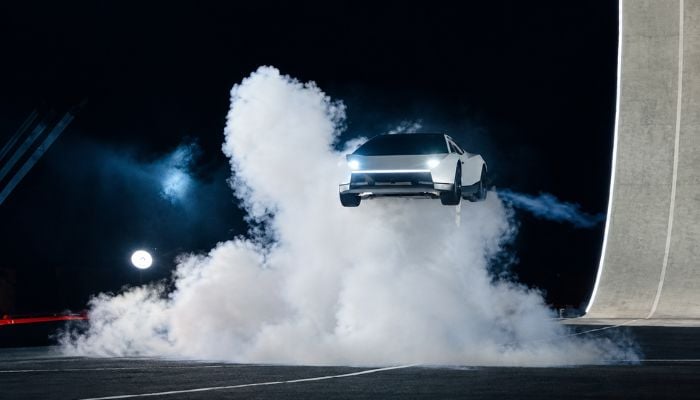
Elon Musk unveiled a redesigned, electric Tesla Roadster which is developed in partnership with SpaceX.
Dubbed as “flying car” the vehicle is equipped with cold-gas thrusters that allow it to perform flight-like manoeuvres.
Speaking about its speed and acceleration, the car accelerates from 0 to 60 mph in 0.81 seconds and has a top speed of over 230 mph.
The vehicle features altitude controls along with main and rear thrusters, enabling it to fly, launch into the air, roll, and do gymnastics manoeuvres.
It also used underbody suction to climb a steep ramp, hang upside down, spin off, flip mid-air and land using air jets. By using the cold-air jets, it leaps over rows of parked Tesla cars.
At a launch event at the SpaceX Rocket Development Facility in McGregor, Texas, a video showed the car launching into the air, emitting white smoke, flipping over several parked vehicles, and landing smoothly. It also used suction to scale a steep ramp and hang upside down.
Production timeline
According to the CEO of Tesla, the production is slated for 2028. While no official total prices were given at the event, Tesla previously quoted a base price of $200,000 nearly a decade ago.
‘Success is not guaranteed’
Musk acknowledged the car is "not necessarily a safety-optimized car," but focuses on fun. “Success is not guaranteed,” Musk said. “I mean that. It’ll probably work, but if it doesn’t work, we’re at a safe distance.”
Its legality and practicality on public roads remain unclear.
According to experts and industry leaders, the event demonstrated “short hopping” tactics rather than sustained and long-range flight.
Roger Conner, curator for vertical flight at the Smithsonian’s National Air and Space Museum said, ““Aircraft are extremely sensitive to weight, whereas with ground vehicles you want them to have bumpers and crumple zones and all that.”
Moreover, road vehicles require heavy safety features like bumpers and crumple zones. Combining both usually results in a vehicle that performs poorly in both environments and is extremely expensive.
Jim Dukhovny who is CEO of eVTOL competitor Alef, noted that while short vertical hops are feasible but transitioning from vertical lift to stable forward flight without losing lift is “extremely difficult.”


-
 Meta releases Muse Spark for Mac-optimized AI: What to know
 -
 OpenAI, Anthropic subpoenaed by FTC over AI safety incidents and consumer harms
 -
 China’s ByteDance makes major AI safety push with global hiring drive
 -
 Can Wall Street keep rogue AI out of its systems?
 -
 Tim Cook announces major Apple Intelligence update for China
 -
 OpenAI sued by eight states over ChatGPT youth safety and mental health risks
 -
 1.3GW solar farm, 1GW data centre planned near King's Lynn
 -
 AI agent hacks are 'early warning shots': Google DeepMind co-founder
-
 Russia cracks down on AI bears as real attacks spread fear: What to know
 -
UK media watchdog warns X over illegal hate content despite moderation speed improvements
-
OpenAI vs. Apple: Former employee accused of taking unreleased device files
-
Google DeepMind, Google Cloud grant European researchers access to frontier AI models and $3M in compute