NASA Hubble spots strange 10-sided ‘decagon’ swirling around Saturn’s south pole
Saturn northern hemisphere consisted of a northern hexagon, persisting for over 40 years
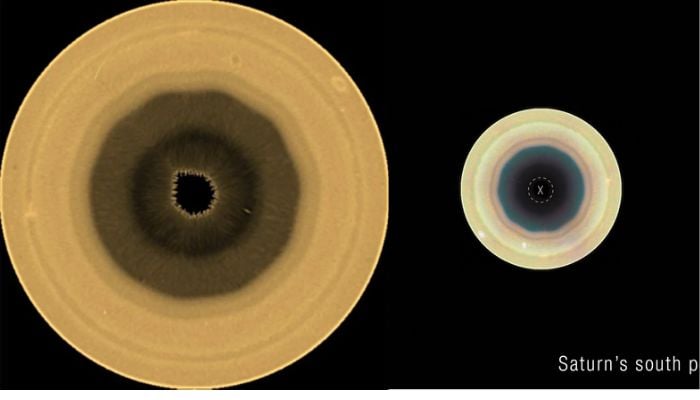
NASA Hubble telescope has unlocked the mysterious nature of Saturn by revealing a giant atmospheric wave named, a decagon, surrounding its south pole.
This is the very first time NASA spotted a regular-sided jet pattern in the southern hemisphere.
While compared to the North which consisted of a northern hexagon, persisting for over 40 years, the recently discovered phenomenon, the southern decagon, is appearing to be strengthening.
In 2023, the new jet stream started appearing in Hubble data. It was first identified in ground-based amateur and professional images starting in 2024 through 2025.
As per researcher, the uniquely weird structure is thought to be formed between 2017 and 2023 when Saturn’s south pole was shifted away from Earth and out of view.
As per findings published in the journal Science Advances, the structure could still be evolving with a single side of the decagon already surpassing 10,000 miles.
The decagon is a vertically extended atmospheric wave embedded in a powerful jet stream rather than just a shallow, cloud-level feature. The decagon is moving eastward at a speed 6mph contrary to the hexagon which is stationary.
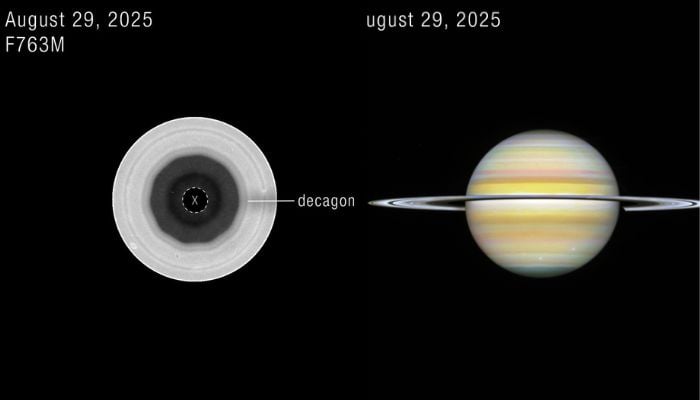
According to lead author of study Agustin Sanchez-Lavega with the University of the Basque Country, these findings are important as it exhibits the “unique hexagon in the northern hemisphere is not as extraordinary as we thought.”
“Saturn still has the ability to surprise us,” the University of Leicester’s Leigh Fletcher said in a statement.
“This is a highly interesting phenomenon that appears to be unique to Saturn, and we want to know why,” Sanchez-Lavega, adding the findings can be helpful for scientists in understanding the weather patterns of giant gas planets after comparing two formations on opposite ends of Saturn.
The researchers are still clueless about the age of the decagon. “For the time being, all I can confirm is that the decagon is still there,” Sanchez-Lavega said.
Speaking about the next steps, researchers plan to use Hubble, the James Webb Space Telescope , and computer models to study how the feature formed, what drives it, and whether it will stabilize like the northern hexagon.


-
 Orionid meteor shower 2026: Peak date, viewing tips and what to expect
 -
 Why Mars looks blue in NASA’s unedited curiosity panorama?
 -
 Blue Origin upgrades new Glenn rocket launch infrastructure to take on SpaceX
 -
 NASA’s next Mars mission targets Phobos and Deimos, not Red Planet
 -
 Is AI ready to rewrite our understanding of physics?
 -
 Astronomers identify possible first green star in 27 years of research
 -
 New study sounds alarm as Doomsday Glacier melts more aggressively than thought
 -
 Hubble data hints at planet born after its star died