Europe’s total solar eclipse 2026: When and where to watch the rare celestial event
The 2026 eclipse is the first of three successive solar eclipses visible from Spain
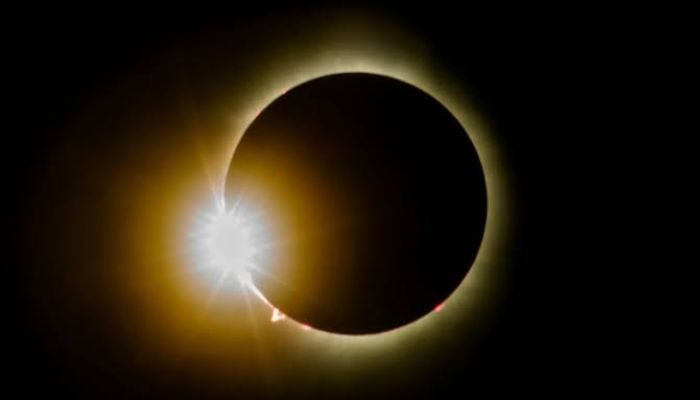
Skywatchers are gearing up for a total solar eclipse which will be visible in mainland Western Europe for the first time since 1999, with the Moon’s core shadow crossing northern Siberia, the Arctic Ocean and eastern Greenland before passing over western Iceland and reaching northern Spain.
Meanwhile, it snaps across northeastern Portugal before ending at sunset over Spain’s Mediterranean coast and the Balearic Islands.
The greatest duration of totality will occur over the North Atlantic, west of Iceland Reykjavik will see totality at 5:48 p.m. local time, while parts of northern Spain including A Coruna and Bilbao will enter low-altitude totality starting at around 8:28 p.m. local time in northwestern Spain. On the contrary, Madrid and Barcelona will see a partial eclipse in most areas of Europe.
A total solar eclipse occurs when the Moon is closer to Earth and ample enough to entirely cover the Sun. Notably, a partial solar eclipse will be visible across many parts of the Northern Hemisphere outside the path of totality.
Skygazers can view across most of Europe, including the UK, Ireland, France and Italy, where observers will be able to see the Moon covering a substantial part of the Sun before sunset.
The eclipse will be partially visible from northern and eastern Canada, Alaska and the northern United States in North America. In order to catch the best view, proper solar viewing glasses are required throughout the eclipse as looking directly at the Sun is dangerous.
It is pertinent to mention here that totality will return to North America in 2044 when the Moon’s shadow will cross western Canada and the western United States followed by a transcontinental eclipse across Canada and the United States in 2045.
The eclipse will reach its maximum in Western Europe and northwestern Africa. The UK’s next total eclipse is in 2090, France’s in 2081 and Germany will not see one until the upcoming century.
The 2026 eclipse marks the first of three consecutive solar eclipses visible from Spain, followed by another total solar eclipse observed on August 2, 2027, with a path sweeping across southern Spain and reaching across Morocco, Algeria, Tunisia, Libya, Egypt, Saudi Arabia and Yemen. Furthermore, an annular solar eclipse on January 26, 2028, will also be visible from Spain.


-
 Earth is splitting apart beneath the Pacific Northwest: Here’s why
 -
 Google's AI Satellite Prototype Launches on SpaceX October 1
 -
 Google plans first AI chip test in space under project Suncatcher
 -
 Mars Rover reveals hot groundwater once flowed at Jezero
 -
 NASA’s PRIMA telescope has one big mission: 'Decode cosmic evolution'
 -
 Northern lights could light up skies across 22 US states tonight: How to watch
 -
 First-ever radio signal from exoplanet reveals its magnetic field
 -
 Starship flight 14: Why SpaceX’s first-ever orbital test matters to NASA’s Artemis