Chinese military researchers are using US AI models to train defense systems: Here’s why
Distillation has become a boiling point in US-China ties as AI competition intensifies
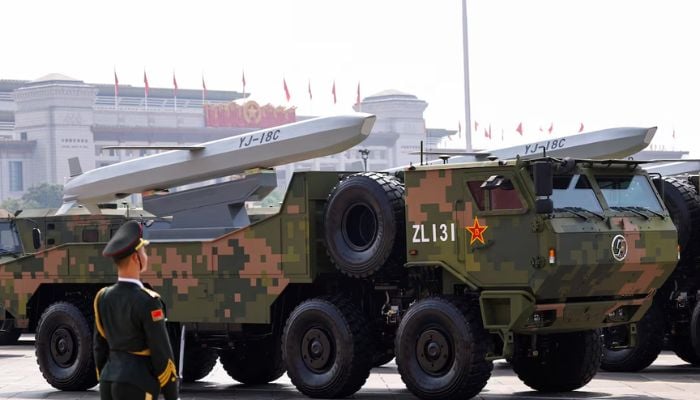
Chinese military researchers linked to the People’s Liberation Army have leveraged US artificial intelligence models developed by OpenAI and Anthropic to train domestic AI systems and advance China’s military strength.
The new data provides an exclusive look into how military and security-linked institutions in China are employing cutting-edge US AI models as a shortcut to developing systems of their own despite Washington’s efforts to limit access to advanced chips and other key innovations.
The documents reveal a prevalent approach of a technique known as model distillation in which outputs from a powerful AI system are used to train smaller models that can be deployed locally without the high computational overhead needed to build frontier AI systems from scratch.
According to a Reuters’ review, research compiled by the Washington-based Jamestown Foundation and shared with the news outlet indicated that distillation is widely used by researchers connected to the People’s Liberation Army and other military institutions.
The issue underlined the intense disagreement ahead of US-China talks on AI governance and safety as US officials have accused some Chinese entities of using distillation to derive functions from American AI models potentially finding ways and infringing on intellectual property rights.
China has refuted the charges saying Washington is pursuing AI “hegemonism” while arguing that US firms have engaged in analogous customs. In this connection, a Jamestown fellow who analyzed over 60 of the papers, Sunny Cheung said: “Teaching a model the right answer is one thing but teaching it the reasoning behind the answer is much harder.”
“These papers show Chinese military-linked researchers are trying to transfer that expensive, proprietary reasoning from Western models into smaller systems they can control and deploy locally,” he continued.
Distillation process explained
Chinese researchers have used distillation for specific purposes highlighting a continuous sequence or range between two extreme points, according to a Reuters review of the papers.
The company further noted that distilled models may lose the original systems’ safety guardrails, enabling high-risk capabilities to be transferred to models beyond its control. China has embraced distillation as it aims to contend with the US in frontier AI while facing constraints on advanced computing resources.
Central and local governments have advocated model compression and research funding for technologies that enable AI models to run drones, satellites and other devices with limited processing power. Nonetheless, as Chinese AI models close the gap with their US counterparts, military researchers are also analyzing distillation as a potential threat.


-
 Apple's foldable iPhone hits stores
 -
 Apple reclaims title as world’s most valuable company overtaking Nvidia
 -
 French parents underestimate children’s AI use, survey finds
 -
 China clears DeepSeek and MiniMax for global AI deployment
 -
 Greece's social media ban for children under 15 will take effect on January 1, 2027
 -
 What Is PHP, why is everyone talking about it?
 -
 OpenAI partners with Poland’s NASK to strengthen AI safety
 -
 YouTube custom feeds could finally fix your homepage