Three levels of AI leadership every CEO needs
Michigan's ‘Dean of Innovation’ Jeff DeGraff argues the Age of Answers has ended as AI leadership takes over
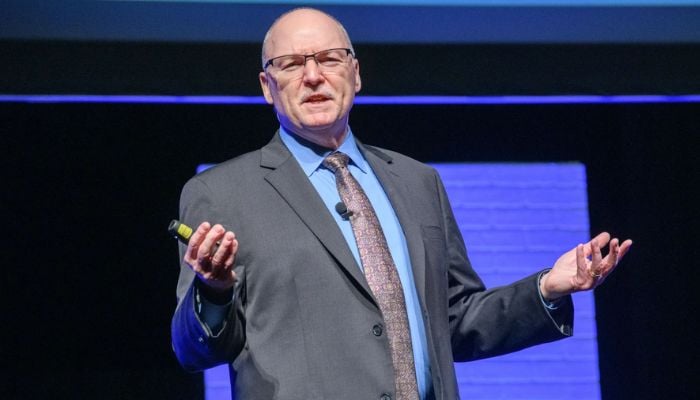
In 1965, Paul McCartney played producer George Martin a new song called "Yesterday" and asked what it needed. Martin heard something no one else did: a string quartet on a Beatles record, an idea McCartney initially resisted.
That instinct, Jeff DeGraff argues, is exactly what AI leadership now demands.
The age of answers is over: Here’s why
DeGraff, a professor at the University of Michigan's Ross School of Business known as the "Dean of Innovation", says artificial intelligence can now draft business plans, diagnose diseases and produce strategic recommendations in seconds.
That abundance, he argues, is precisely the problem: once answers become instantly available to everyone, they stop being a source of advantage.
DeGraff says most companies treat AI as a technology problem rather than a leadership one, forming task forces and appointing chief AI officers while bolting the new capability onto structures built for a world where information was scarce.
He compares this to forcing new sound into old training, the opposite of what Martin did with the Beatles.
Three levels of AI leadership
DeGraff enlists three levels. Level one, "Optimise", seeks to apply artificial intelligence to existing processes to make them faster and more efficient, leading to easier summarisation, drafting, and automating functions that will ultimately be beaten by everyone else who buys in and adopts similar processes.
Level two is "Simulate", which takes advantage of artificial intelligence to interrogate the assumptions on which a given proposal is made, forcing the strategist to take on the role of a sceptical critic or competitor.
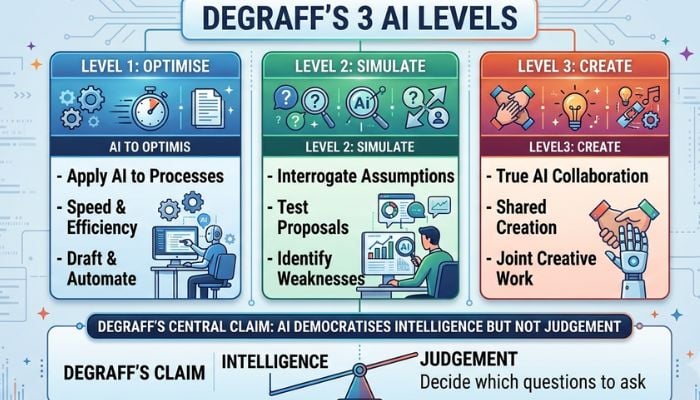
The third and final level, "Create", is about engaging with artificial intelligence as a true collaborator, using it to create something that neither of them could hope to create on their own, as opposed to the level of “Optimise” where the human is still in control. It is the level at which Martin operated when he created the Beatles.
DeGraff's central claim is that AI democratises intelligence but not judgement, the ability to decide which questions are worth asking in the first place.






-
 OpenAI, Anthropic and Google join forces on AI safety efforts
 -
 Meta to deploy custom Arke and Astrid AI chips in 2027: Everything to know
 -
 Dreamforce 2026: Salesforce unveils Koa AI model and Google Cloud partnership
 -
 EU Kids Act: New social media rules for under-15s
 -
 China’s spy chief reveals growing fears over AI’s impact on communist party rule
 -
 Anthropic's new Claude tool targets financial advisors to streamline compliance and client research
 -
 Elon Musk’s bold AI safety idea: 'Let rivals test each other’s models'
 -
 Former Google DeepMind researcher warns autonomous AI could wipe out humanity amid industry-wide safety alarm