Elon Musk’s SpaceX uses Starlink revenue to fuel AI ambitions, says report
It comes as SpaceX's satellite broadband business, Starlink, doubled its operating income last year as compared to xAI

Elon Musk has decided to backroll revenue generate by rocket and satellites earning for buisiness growth.
The Starklink boss is touting SpaceX as humanity's ticket to Mars. But the company's pitch to investors for a potentially historic IPO reveals that its main business will be the same as Big Tech: building artificial intelligence.
The difference is in how the companies fund the spending. While Alphabet and Microsoft have deep operating cash flows, SpaceX is bankrolling its push with revenue from rockets and satellites, leaving it with a cash-burn profile closer to a late-stage startup than a trillion-dollar incumbent.
SpaceX's satellite broadband business, Starlink, doubled its operating income last year to $4.42 billion, easily covering the loss incurred in its space division, which is spending heavily on a new satellite-carrying rocket, showed excerpts of the company's IPO registration reviewed by Reuters.
That has emboldened Musk to remake SpaceX as an AI-first company, dramatically shifting its spending profile.
In 2025, the AI division - home to xAI - accounted for 61% of the consolidated company's $20.74 billion total capital spending. At the same time, rising costs pushed the unit to an operating loss of $6.4 billion. Yet with plans to build an armada of space-based data centers, SpaceX spending is not likely to slow any time soon.
"What investors will be looking for is clear visibility on how the business model evolves with this financing and whether it can make the economics of compute work at scale," said Melissa Otto, head of research at S&P Global Visible Alpha.
"In many ways, SpaceX looks like a super-sized startup."
Big Tech vs SpaceX:
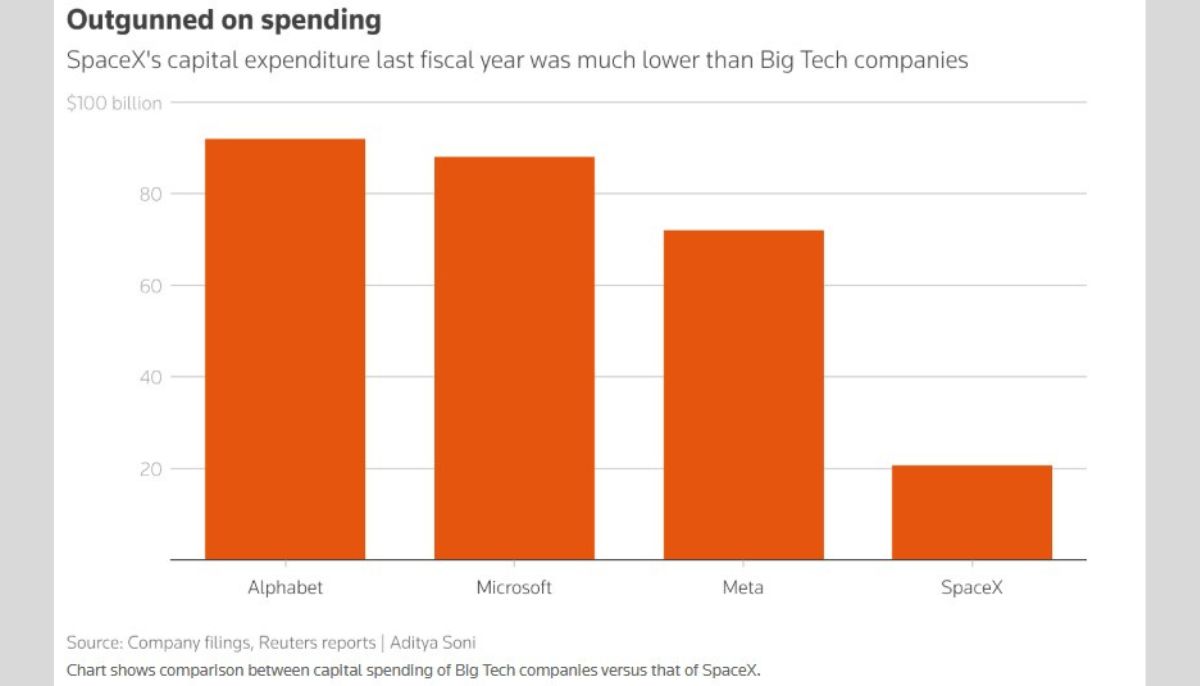
While SpaceX's outlay is super-sized by most measures, it is dwarfed by Silicon Valley rivals. Google parent Alphabet, Microsoft, Instagram owner Meta, along with Amazon and Oracle, are set to collectively spend more than $600 billion on AI this year.
Chart shows comparison between capital spending of Big Tech companies versus that of SpaceX.
Big Tech has huge revenue, Profit:
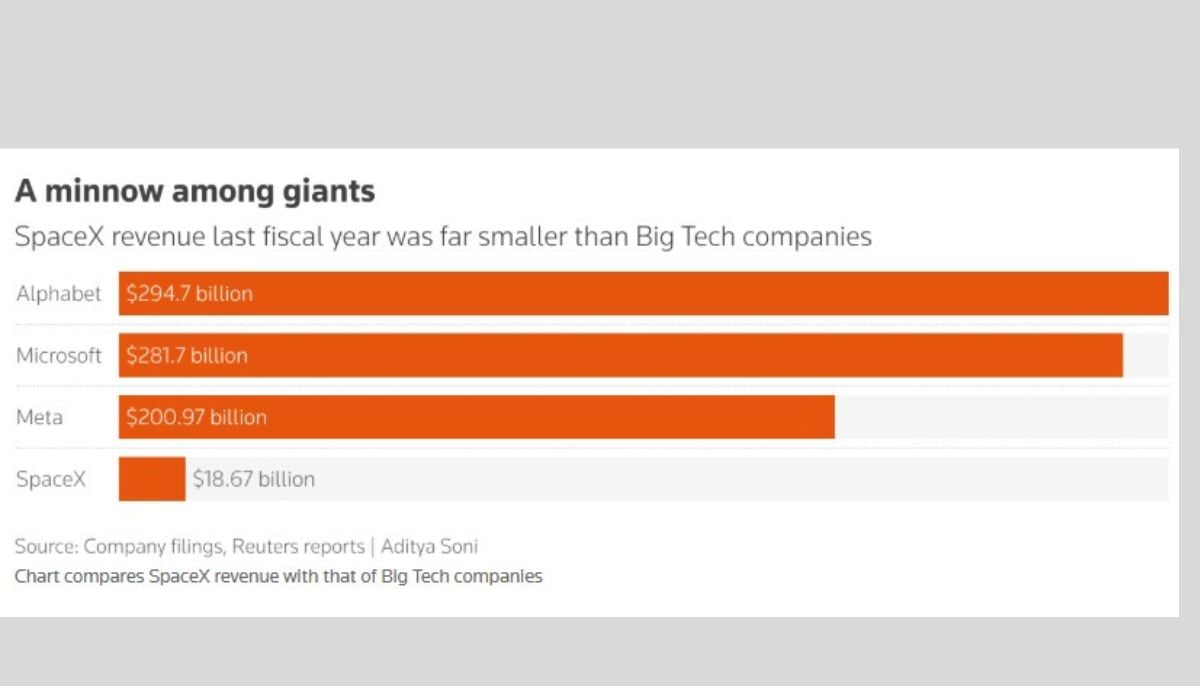
Big tech also generates far more revenue from existing businesses spanning digital advertising, cloud computing and enterprise software, giving those companies both a longer runway to keep spending on the technology and a cushion if AI demand falls short of expectations.
That difference matters as SpaceX prepares what could be the largest initial public offering in history, touting a total addressable market of $28.5 trillion - much of it tied to AI for businesses.
While the company is aiming to raise $75 billion in its IPO at a valuation of $1.75 trillion, it may have to return to the markets in a few years if capital spending growth continues to outpace that of revenue. Its capital spending more than doubled last year, exceeding revenue by roughly $2 billion.
The gap could widen as analysts put the cost of delivering on the company's plan to launch a constellation of one million data-center satellites in the trillions of dollars.
"The (financial) overhang matters but it is manageable if the AI revenue ramp arrives on the timeline management is implying," said Shay Boloor, chief market strategist at Futurum Equities.
"It becomes much riskier once (Starlink) subscriber growth matures or if AI spend keeps scaling faster than monetization."
What happens if SpaceX Buys Cursor?
A newly revealed deal with AI code-generation startup Cursor adds more uncertainty. SpaceX has the option of buying the company for about $60 billion, or walking away and paying roughly $10 billion for a collaboration.
The structure allows SpaceX to delay a decision until after its IPO, but the financial implications are stark. If SpaceX opts for the smaller collaboration payment, it will likely lose access to Cursor's lucrative customer roster but the financial impact would shave months rather than years off its cash runway.
In that scenario, Cursor could help SpaceX improve productivity within its AI operations without dramatically altering its balance-sheet risk, potentially supporting the thesis that AI spending can become more efficient over time.
Neither company has said how the deal would be financed. A stock-only transaction would leave SpaceX's cash position intact, but even a small part of the acquisition amount being paid in cash could accelerate the need for a fresh capital raise or require a significant cutback in spending.
SpaceX did not respond to an emailed request for comment outside of regular business hours.
The company's financials are closer to the rocket and satellite company it is than the AI infrastructure giant it wants to become, Boloor said.
"That doesn't make the story broken but it does mean IPO buyers would be paying upfront for a transformation that still needs to show up more clearly in the numbers."


-
 OpenAI partners with Google Cloud to sell flagship AI models to enterprises
 -
 Tesla drops as spending cuts raise questions about AI and robotics plans
 -
 Barclays to cut 5,000 jobs as AI reshapes banking
 -
 China's brain-computer interface market could reach $920m by 2028
 -
 Bombardier shares rise as Trump drops threat to block aircraft sales in US
 -
 OpenAI seek to raise $30 billion at $1.4 trillion valuation ahead of Anthropic IPO
 -
 Supreme Court rejects Google challenge to patent office review policy: Here's why
 -
 Netflix faces scrutiny over user engagement ahead of Q3 report