China vs US: Artemis II mission drives new Moon race momentum
Paris Observatory scientist highlight how lunar resources could shape future space missions and infrastructure
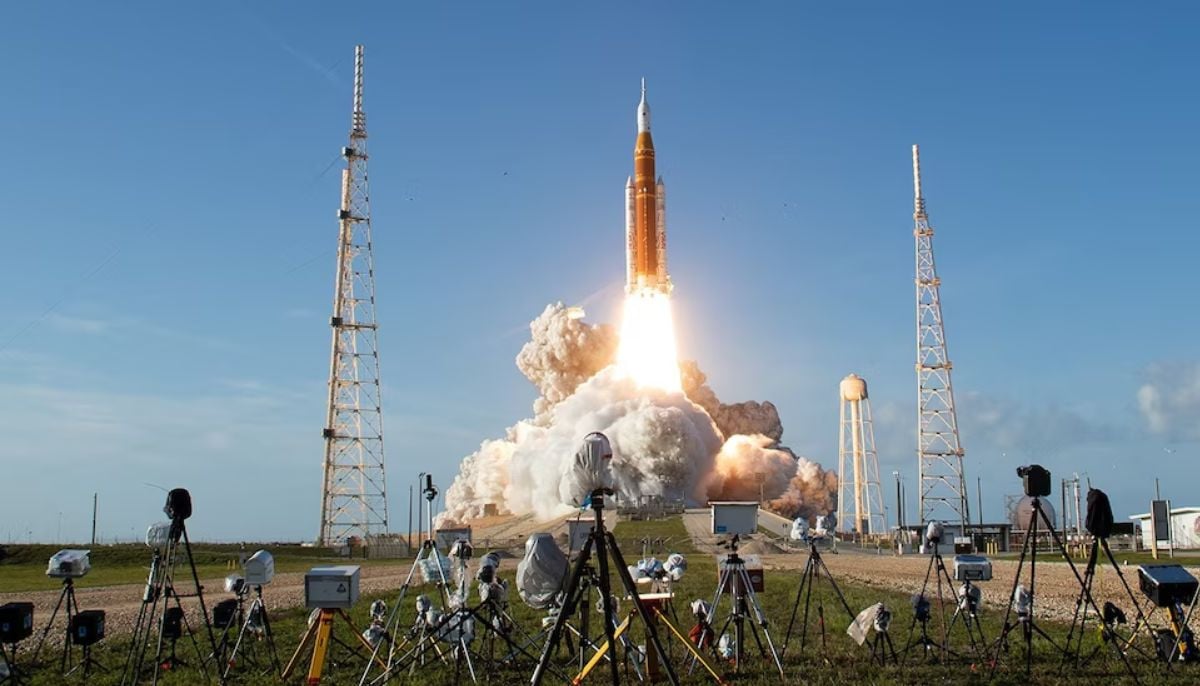
The lunar surface has been a graveyard of footprints and discarded machinery for over half a century. The Moon's silence began to end with NASA's Artemis II programme, which started its mission to the Moon on April 01 on a 10-day journey.
We are no longer just visiting; we are moving in.
Explaining the change, Paris Observatory astronomer and physicist Shaheer Niazi puts it this way: “Fifty years ago, humanity achieved its first lunar landing through the Apollo space programme. Twelve astronauts walked on the lunar surface. But after that, decades passed, and the Moon remained an untouched frontier.”
Today, that frontier is being claimed by a new generation of explorers who see the Moon not as a destination but as an alternative residence for humanity.
He goes on to add that NASA's move is aimed at breaking this long pause and to establish America's supremacy in space, which has been challenged by China and Europe.
From Apollo to Artemis II
The Artemis programme advances its mission through successive missions that decrease operational risks while preparing for human astronauts to land on the Moon. The Artemis I mission demonstrated the safe Moon orbit and Earth return capabilities of the Space Launch System rocket and the Orion spacecraft through astronaut-less testing.
The sequence begins with Artemis II, which marks the initial human-operated mission. The mission aims to evaluate life-support systems and navigation capabilities and astronaut performance during deep space operations.
“Artemis is conducting a series of tests and will eventually land humans on the Moon. Right now, Artemis II took an orbit around the Moon, but the upcoming missions will soon deploy people and a space habitat, which will be built on the South Pole of the Moon,” Niazi added.
More importantly, the South Pole has become a focal point due to its resources, supporting sustained missions because this side of the Moon contains frozen water which supports life and serves as fuel because it receives almost perpetual sunlight, which makes it suitable for permanent operations under the Artemis Moon Race programme.
“They will conduct this mission on the South Pole because of its importance. It's important because there are volatile substances thought to be there, frozen water and hydrogen, which can act as fuel for these future habitats,” Niazi highlights.
The Artemis Moon Race is no longer limited to one country, with China emerging as a strong competitor.
“The United States, however, is not alone in this pursuit. China has also announced its intention to conduct a crewed lunar mission by 2030. China already successfully landed rovers on the far side of the Moon, a feat which no other nation had accomplished.”
Artemis II fuels US-China Moon race
Modern space exploration faces growing competitive challenges yet maintains cooperation as its essential development framework. Niazi raises question on if the Moon conflict represents a new Cold War while questioning whether the space competition between nations has transformed into a Moon race. According to him, officially both countries support peaceful collaboration.
The future development of lunar movement and base construction work is receiving its initial guidance from international partnerships which are currently in operation.
Highlighting the future developments, Niazi says that the space agencies of America and Canada and Japan are working together with the Japanese space agency JAXA to develop a moon vehicle which will serve as the primary method of lunar transportation.
The space team will create new applications for existing technology which will enable humans to operate equipment beyond Earth.
"So yeah, there will be a Toyota on the Moon in the near future," he added.
The Artemis Moon Race plan extends beyond its initial goal of marking territory through landings because it aims to achieve permanent human presence on the Moon.
The Apollo programme began as a quick mission which later developed into a space race, but Artemis has become a long-distance competition for space exploration. According to Niazi, the first human settlement on the Moon, together with its operational base, will exist on the South Pole by the year 2030, which will develop into a complete base until 2040.






-
 Scientists found 'super-puff' planets 1,110 light-years away
 -
 Scientists find ancient microbial life in places it shouldn't exist
 -
 Why Marijuana is suddenly sending thousands of dogs to hospitals in US?
 -
 36 years on, Hubble shows how stars actually change over time
 -
 Hidden magma beneath Mars? Scientists' 'unexpected' discovery raises new questions about alien life
 -
 Rare 3,200-year-old coral blue hole discovered in South China Sea
 -
 What happens at black hole’s event horizon? Scientists find the first-ever clue
 -
 Scientists discover evidence of fires used by humans 1.8 million years ago
-
 Did NASA just uncover evidence of ancient life on Mars? Key discoveries explained
 -
Four powerful earthquakes strike three continents within hours: Scientific link or coincidence?
-
Mysterious interstellar comet passing our solar system may be 12 billion years old, scientists say
-
When do we really become adults? Science has an answer